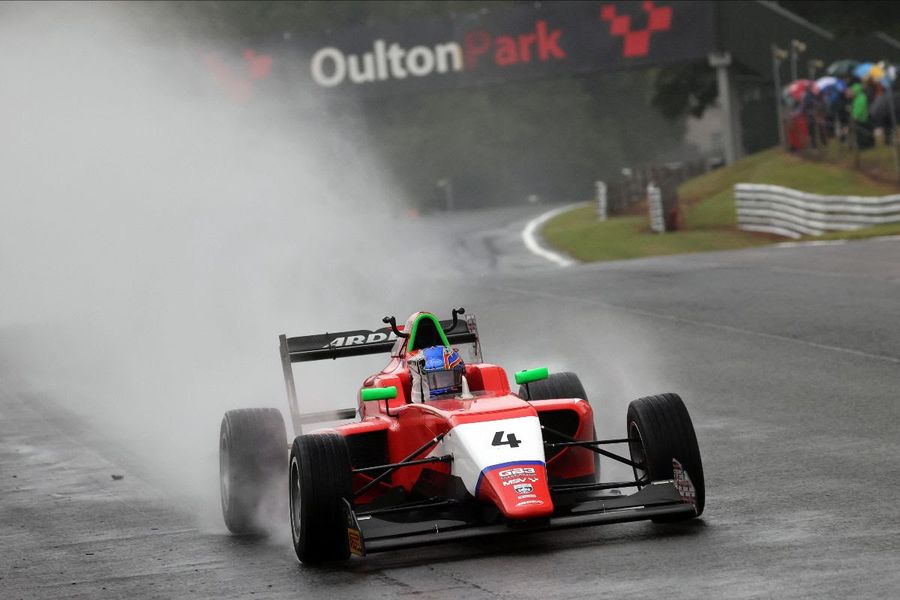













There are numerous good reasons for a race series to adopt a control tyre supplier, as the FIA Formula Two championship has done with Japanese brand Yokohama; consistency, equality and of course, control. And while it means that every driver and team are provided with the same tyres and hence opportunities, it places a huge demand on the supplier and in this case, the UK distributor, Yokohama HPT Ltd, which services the F2 operation.
The Formula Two championship is organised by Dr Jonathan Palmer's MSV company, based just north of Bedford in the Home Counties and less than an hour from Yokohama's base in Milton Keynes. Administered centrally, this is part of the reason that Formula Two is so cost-effective, as drivers can concentrate on the driving and don't have to pay for separate engineers, mechanics, transport and hospitality that is often the case in other open wheel championships.
Providing the ADVAN A005 and A006 racing tyres through Yokohama's UK facility was a logical step for several reasons; the company is geographically close to MSV's base, it has a huge amount of motorsport experience and its purpose-built facility is capable of storing a season's worth of tyres for the entire field.
Speaking of which, this is no small amount of tyres. Working on the basis of up to 20 cars on the grid per round, eight double-header rounds and six sets of tyres per car per weekend minimum, this equates to a requirement of almost 1000 sets of tyres, before any of the pre-and in-season testing takes place.
For a race weekend, each car is permitted four sets of dry ADVAN A005 tyres and two sets of wet ADVAN A006s. Typically, there are two free practice sessions on the Friday of race weekend and each car will use a fresh set of tyres for each free practice.
There is then a separate qualifying session and race on Saturday and again on Sunday and again typically, each car will start its qualifying session on a set of part-worn tyres from free practice to ensure the car is working perfectly. Once happy that the car is set-up correctly, there is a flurry of activity in the pit lane, as each driver will come in and swap to a set of brand new tyres to try to post their best time for that afternoon's race.
It's worth mentioning that in Formula Two, there are no F1-style frenzied pit stops - each race runs without scheduled stops and part of the system to make the series such good value is that there is a single mechanic dedicated to each car, with engineers split across three cars and a back-up 'shunt' crew who help out where needed. Only the car's mechanic is allowed to change the wheels and tyres, so it's crucial that the drivers pick the right moment to swap from their old to new tyres to allow them enough time to post a good lap-time.
While each car has an allocated number of tyres, recorded via barcode by the FIA, there are inevitably times when tyres need to be changed, as a result of contact between cars, damage caused by excessive wheelspin from the 1800cc turbocharged cars or in case of a full wet three-day event.
In this case, Yokohama's state-of-the-art refit line and on-site technicians are capable of changing the entire field of wheels and tyres overnight, if required. Thankfully, it rarely is, as tyres are usually removed and refitted to the stock of wheels at the Yokohama Milton Keynes facility well in advance of each race.
Richard Gates, Formula Two Race Operations Manager, said: "Yokohama has been very proactive in working with us to design a new tyre suitable to our specific needs. Throughout the process we've received full technical support from both the UK and the headquarters in Japan, as well as during race events where the Yokohama team have assimilated quickly and easily into the F2 environment, including helping drivers with all their needs."
Yokohama HPT Ltd Head of Motorsport, Mark Evans, said; "Of course we were honoured when Yokohama was selected to provide control tyres for the FIA Formula Two Championship and immediately began to plan for the season. We knew we had plenty of capacity for storage and pre-event preparation at our Milton Keynes base but we also knew that the series didn't have its own dedicated on-event equipment, so we began designing a system that would travel with the rest of the F2 operation around Europe.
"Being located so close to MSV's base is very handy, as it means that we can react very quickly to changing demands and in particular, when developing the on-event infrastructure at quite short notice.
"I am very pleased with how the system has worked so far. We had a situation recently where we were at the Nürburgring for two weekends in a row, for the 24 Hour race followed by the next two Formula Two rounds and on this occasion, we elected to fit wheels and tyres at the circuit. The system worked very well and our technicians, Simon and Mark, were able to refit a set of wheels and tyres for each car, with help from the F2 team."
The series' next round is at Spa-Francorchamps this coming weekend. However, the most challenging time will be in July, with two rounds at Brands Hatch in Kent followed the next weekend by two at Paul Ricard in France. There will just be enough time for the Yokohama team to dismantle, remount, inflate and balance the 600 wheels and tyres required for the following weekend and another three days of exceptional racing action, courtesy of Formula Two and potentially, the next generation of Formula One drivers.