







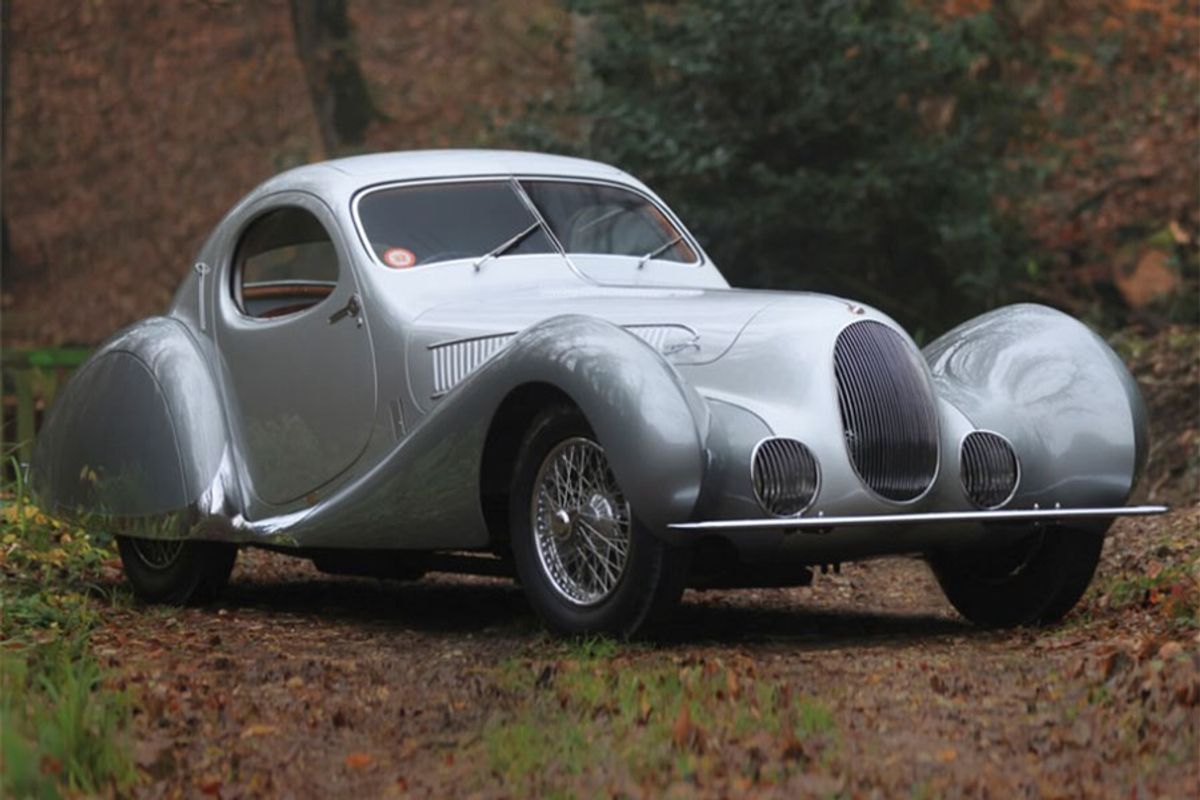
1938 Talbot-Lago T150-C-SS Teardrop Coupe - Estimate: EUR 6,500,000 – EUR 7,500,000
Extraordinary Example of One of the All-Time Great French Automobiles
Features a Race-Derived, High-Performance T150-C-SS Chassis
Definitive Modèle New York Teardrop; Regarded as Joseph Figoni’s Masterpiece
Displayed at the Brussels, Paris, and Deauville Concours d’Elegance in 1939
Awarded First in Class at Pebble Beach and Best of Show at Meadow Brook
Chassis 90112
SPECIFICATIONS
3,996 CC OHV Inline 6-Cylinder Engine
Three Stromberg Carburetors
140 BHP at 4,100 RPM
4-Speed Wilson Preselector Gearbox
4-Wheel Mechanical Drum Brakes
Front Independent Suspension with Upper Wishbone and Lower Transverse Semi-Elliptical Leaf Spring
Rear Live Axle with Semi-Elliptical Leaf Springs
Few automobiles embody the artistic and cultural spirit of prewar France as completely as the Talbot-Lago T150-C-SS “Goutte d’Eau.” The Teardrop, as it later came to be known, emerged from the inspired collaboration of Anthony Lago and Joseph Figoni – Italian-born émigrés who helped define the exuberant Parisian automotive landscape of the 1930s. Their partnership produced a small number of grand sporting cars that blended advanced engineering with sculptural coachwork, and none more dramatically than the Figoni et Falaschi-bodied coupes that remain among the most celebrated automotive designs ever created.
Antonio Franco Lago, born in Venice in 1893, was a charismatic and determined figure who built his early career in the London motor trade during the 1920s. By 1933, he had identified a remarkable opportunity in the ailing French automaker Automobiles Talbot-Darracq S.A., headquartered in Suresnes outside Paris. The company – by then a subsidiary of Sunbeam-Talbot-Darracq – was on the brink of collapse. Through bold and strategically deft negotiations, Lago secured control of the marque and immediately began shaping a new identity for Talbot. His vision centered on elegant road cars, competitive racing machines, and high-quality engineering that would reassert France’s standing in the increasingly sophisticated European luxury market.
Lago’s first major statement came at the 1934 Paris salon with the debut of the T150 Grand Sport prototype. The car showcased the combined strengths of the revitalized firm: sleek coachwork styled by Joseph Figoni, a robust inline six-cylinder engine engineered by Walter Becchia, and the innovative Wilson preselector gearbox – an advanced and smooth-shifting transmission for which Lago held the patent rights. Determined to amplify public interest, Lago turned to motorsport. The T150-C competition cars, built for the ACF’s new four-liter formula introduced for 1936, quickly proved formidable under talented drivers such as René Dreyfus and Luigi Chinetti, further raising the marque’s profile.
At the 1936 Paris salon, Lago introduced his ultimate road-going sports car: the T150-C-SS. This “Super Sport” variant featured a short-wheelbase, low-slung frame closely related to the company’s competition cars. Under the hood lay a four-liter, 140 hp inline six with three carburetors and a lightweight alloy hemispherical head, providing substantial performance for the era. The chassis incorporated independent transverse leaf front suspension, an underslung rear axle, Rudge knock-off wire wheels, a single-shot lubrication system, and a capacious 120-liter fuel tank suitable for both touring and endurance competition. Offered as a bare chassis priced at 78,000 francs, the T150-C-SS positioned Talbot-Lago squarely among the elite, rivaling contemporaries such as the Bugatti Type 57S and Alfa Romeo 8C 2900.
An extremely limited number of T150-C-SS chassis were produced between 1937 and 1939. They were intended for bespoke coachwork from Europe’s most celebrated coachbuilders, but the most arresting and memorable examples were those shaped by Figoni et Falaschi.
Joseph Figoni, whose family emigrated from northern Italy to the working-class suburb of Boulogne-sur-Seine, had honed his craft at Lavocat et Marsaud before founding his own coachbuilding atelier in 1923. His early work emphasized lightweight, sporting bodies, but it was in the early 1930s that Figoni’s reputation blossomed. In partnership with the influential Alfa Romeo concessionaire Luigi Chinetti, Figoni-bodied 8C 2300s triumphed at Le Mans in 1932 and 1933. His alliance with Anthony Lago beginning in 1934 broadened his exposure, though his small operation was limited by financial constraints.
This changed in 1935, when Italian financier Ovidio Falaschi became his business partner. Although Falaschi served solely as the enterprise’s financial backbone, the partnership allowed Figoni the freedom to experiment boldly with form, proportion, and aerodynamics. The carrosserie’s golden era soon followed. Figoni’s 1936 Delahaye Roadster, inspired by the sinuous illustrations of automotive artist Géo Ham, signaled a radical shift in French styling – embracing voluminous pontoon fenders, flowing beltlines, and a sculptural purity that heralded a new age of streamline design.
Figoni’s most lasting masterpiece, however, was his aerodynamic coupe. Known internally as the Faux Cabriolet but celebrated today worldwide as the Goutte d’Eau or Teardrop, this striking form represented the zenith of 1930s French automotive design. Between 10 and 12 examples were created for the T150-C-SS chassis, in two distinct variations: the notchback Coupé Jeancart, named for its first client, and the fastback Modèle New York, introduced at the 1937 New York International Auto Show.
The car offered here, chassis 90112, is widely acclaimed as one of the most beautiful and distinctive of all Figoni et Falaschi Teardrops. Listed in the coachbuilder’s ledger as order no. 681, its body is of the Modèle New York specification. Completed in May 1938, it left Figoni’s works finished in a deep Noir Iris (Iris Black). It is believed that its first owner was M. Toussaint, director of the Casino at Namur in Belgium – an appropriately glamorous custodian for a car of such elegance.
As chronicled in Richard Adatto’s authoritative work From Passion to Perfection, 90112 made several notable concours appearances in its early years. It appeared at the Brussels Concours d’Elegance in 1939, and later that spring was shown at the Concours d’Elegance de l’Auto in Paris, listed as Entry No. 35 and presented by Swiss actress Myno Burney. For this event, the car wore distinctive white Dunlop tires and was awarded the grand prize for aerodynamic coupes. On July 14, 1939, it was exhibited again at Deauville.
With the outbreak of war and Germany’s invasion of Belgium in May 1940, chassis 90112 vanished from public view. It resurfaced in May 1946 at a concours in Brussels and by 1961 it passed into the ownership of Belgian collector Stéphane Falise, who also owned the ex-King Leopold Bugatti Type 59. For many years, it remained in storage in Falise’s garage, partially disassembled in preparation for a restoration that was never completed. As a result, when ownership passed to a private American collector in 2005, 90112 remained one of the most complete and untouched original Teardrops known.
RM Auto Restoration was entrusted with the task of returning 90112 to concours condition. Remarkably, most of the original wooden framework supporting Figoni’s coachwork had survived; the structure was meticulously cleaned, stabilized, or recreated using traditional materials and methods. The original sheet metal, while largely intact, bore evidence of old repairs and required careful metalwork to restore its original surfaces. Hundreds of hours of surface preparation preceded the final paintwork – executed in a period-correct silver complemented by a subtle gray secondary tone.
The chassis proved exceptionally well preserved and required only cleaning and refinishing. Major mechanical components were rebuilt, refinished, and reinstalled with rigorous attention to originality. To ensure absolute authenticity, the restoration team conducted extensive research and made several trips to study other surviving Teardrops, documenting details to replicate original finishes, fasteners, textures, and mechanical subtleties.
The results were exceptional. In 2009, chassis 90112 debuted at the Pebble Beach Concours d’Elegance®, where it earned three major awards: First in Class, the J.B. and Dorothy Nethercutt Most Elegant Closed Car Trophy, and the ArtCenter College of Design Award. Its acclaim continued in 2010, earning the Breitling Watch Award for the Car of Timeless Beauty at Amelia Island, then Best in Class and Best of Show at Meadow Brook.
Since 2013, this car has resided in a private Swiss collection, unseen in public for over a decade – making this an enticing opportunity for its next owner to return this magnificent Teardrop to the world’s great concours lawns.
For more than eight decades, the Talbot-Lago T150-C-SS has been revered as one of the finest French automobiles of its era. Dressed in Figoni’s incomparable Goutte d’Eau coachwork, the chassis became a rolling sculpture – its lines capturing the optimism, artistry, and aerodynamic fascination of a golden age. The design stands today not only as a landmark in automotive history, but as one of the great achievements of industrial art.
Among the few surviving original-bodied Modèle New York coupes, chassis 90112 is distinguished by its beauty, provenance, exceptional restoration, and decorated concours career. Opportunities to acquire a genuine Figoni Teardrop are exceedingly rare; to do so in Paris, where its creators once shaped the future of automotive style, is rarer still.
Here is a singular chance to obtain one of the most extraordinary French coachbuilt masterpieces ever constructed.
Text & Image: Gooding Christie’s
Gooding Christie’s Rétromobile Auction - Paris Expo Porte de Versaille - 29th January