












COACHWORK BY SCAGLIETTI
CHASSIS NO. 2177 GT
ENGINE NO. 2177 GT
HIGHLIGHTS
Early Production SWB Berlinetta in Desirable “Semi-Competition” Specification
Period Competition History Includes Swiss Hill Climbs and US SCCA Racing
Formerly Part of Noted American and European Collections
Participant in Ferrari’s 50th and 70th Anniversary Celebrations
Documented by Ferrari Historian Marcel Massini and Tokar S.r.l.
Matching-Numbers Engine, Gearbox, and Differential per Build Sheets
SPECIFICATIONS
2,953 CC SOHC Tipo 128F V-12 Engine
Three Weber 40 DCL6 Carburetors
240 BHP at 7,000 RPM
4-Speed Manual Gearbox
4-Wheel Dunlop Disc Brakes
Front Independent Coil-Spring Suspension with Tubular Shock Absorbers
Rear Live Axle with Semi-Elliptical Leaf Springs and Tubular Shock Absorbers
Unveiled beneath the glass canopy of the Grand Palais at the 1959 Paris Salon, the 250 GT Short Wheelbase Berlinetta (SWB) represented a decisive evolution of Ferrari’s dual-purpose GT philosophy. Beneath its harmonious Pinin Farina-styled, Scaglietti-built coachwork lay a more compact and agile chassis developed under the collective brilliance of Giotto Bizzarrini, Carlo Chiti, and Mauro Forghieri. This new platform would soon underpin Ferrari’s dominance in GT racing and give rise to some of the marque’s most coveted road-going and thoroughbred competition automobiles.
Ferrari provided the SWB with a technical specification that signaled a new level of engineering ambition. Four-wheel Dunlop disc brakes, revised suspension geometry, and a substantially stiffened chassis endowed the SWB with a degree of balance, predictability, and precision previously unknown. Powered by Ferrari’s traditional three-liter Colombo V-12 – capable of producing up to 280 hp in full Competizione tune – the Berlinetta delivered formidable performance on both road and track.
Scaglietti constructed the bodies in small, hand-finished batches, offering full aluminum coachwork for competition work, steel for road-going Lussos, and numerous intermediate configurations that blurred the line between the two. As production evolved, details were gradually standardized, leaving the early 1960 examples with a distinctive character: their varied features illustrate both the individual preferences of their original clientele and the rapid pace of Ferrari’s developmental refinement.
Consequently, the first-year cars remain among the most individualistic and technically revealing of all SWB Berlinettas. Relatively early examples, such as the car offered here, are distinguished by their elegant grille shape, distinctive side-window treatment, and external rear-deck fuel filler. In transitional cars, the cockpit air vent was relocated from the top of the rear window to the roof panel. Inside, the SWB exhibits the purposeful simplicity of a thoroughbred Ferrari GT machine, with a wrinkle-finished dashboard highlighting twin instrument nacelles, bolstered bucket seats, and lightweight aluminum trim.
By the end of the 1960 racing season, the 250 GT SWB had proven itself a formidable competitor. It captured that year’s Tour de France Automobile; secured class victories at Le Mans, Goodwood, Montlhéry, and Spa, and established itself as the premier GT car of the era.
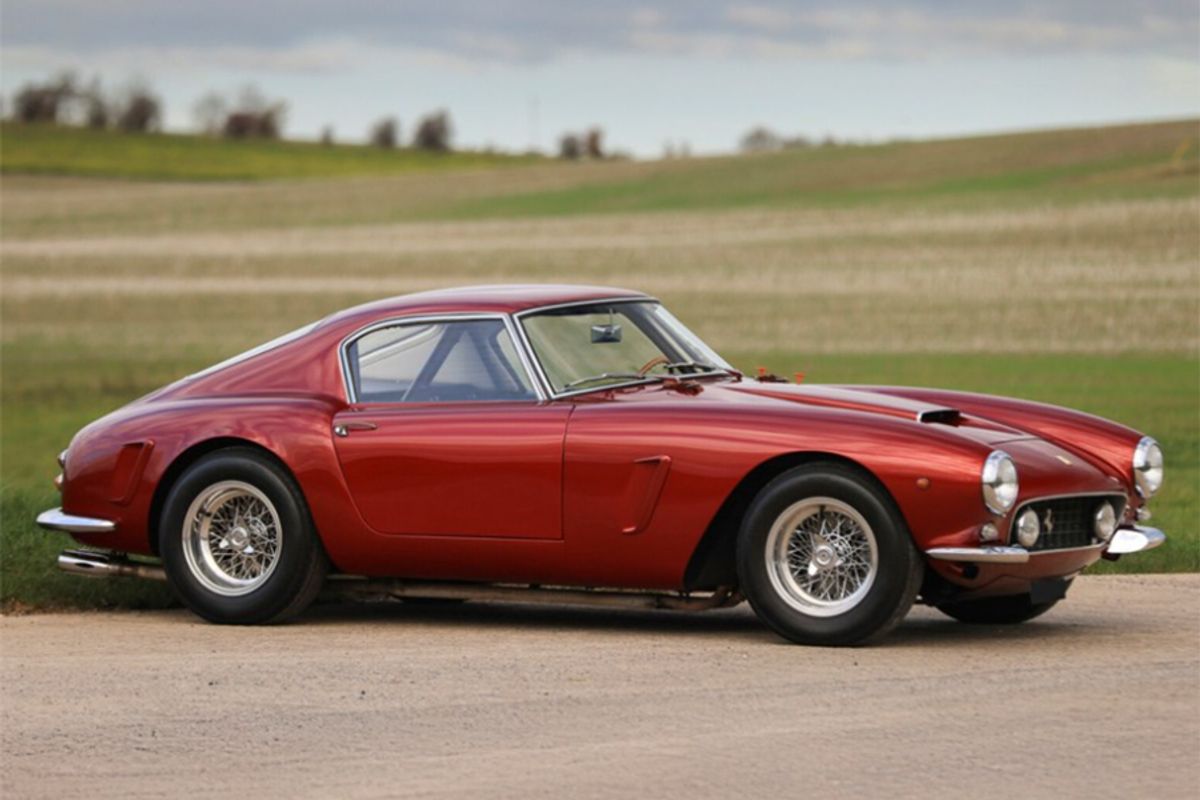
Completed in October 1960, chassis 2177 GT embodies the compelling dual-purpose character that defines the most desirable Short Wheelbase Berlinettas.
According to historian Marcel Massini, this car was delivered new to Italauto SA, the Lausanne concessionaire operated by Baron Emmanuel “Toulo” de Graffenried, and sold to a Swiss resident named Zimmerman. Copies of the factory build sheets reveal a specification clearly intended for spirited driving. The original engine – still retained today – was equipped with Weber 40 DCL6 carburetors and an Abarth competition exhaust, producing a stout 243 hp with a 9.4:1 compression ratio. A ribbed-case alloy competition-type gearbox and 8x32 final drive further confirmed Ferrari’s intent that the car excel on winding alpine roads and hill climbs. Other notable equipment included a 100-liter fuel tank, Miletto shock absorbers, Borrani RW3598 wire wheels, and unassisted Dunlop disc brakes.
The bodywork represents a rare, attractive, and sought-after late-1960 configuration. While constructed around a steel shell, the Ferrari incorporates lightweight aluminum doors, bonnet, and bootlid, along with single-thickness alloy floors, aluminum trim, and competition-style quick jack brackets. It was originally finished in the elegant and seldom-specified livery of Rosso Rubino Chiaro (Light Ruby Red) with black leather upholstery and instruments calibrated in kilometers.
In 1962, chassis 2177 GT was acquired by Geneva banker and gentleman driver Armand Boller, who promptly entered the car in one of Europe’s most storied motoring events: the Ollon-Villars Hillclimb, then part of the European Mountain Championship. On August 25, 1962, Boller achieved 5th in Class, affirming the SWB’s competition credentials. The following year, Boller acquired a 250 GTO and sold 2177 GT to Walter Ringgenberg of Bern. A respected hotelier and capable privateer in his own right, Ringgenberg entered the Ferrari in several Swiss hill climbs throughout 1964. At Mitholz-Kandersteg in May, he secured 3rd in Class, followed by 2nd in Class at Sierre-Crans-Montana in August, a round of the International GT Manufacturers Championship.
This Ferrari next passed to renowned American Ferrari dealer and racer Bob Grossman, who acquired it through the Fribourg, Switzerland garage of Paul Blancpain and Jo Siffert. Grossman, whose association with Ferrari racing in North America endures today, entered 2177 GT in the 1966 Mount Equinox Hill Climb in Vermont. The following year, he sold the car to accomplished SCCA competitor Dudley Cunningham of Massachusetts. Cunningham campaigned the SWB with enthusiasm throughout the late 1960s, racing it at venues such as Lime Rock and even displaying it at the 5th Annual Ferrari Club of America National Meet, held in March 1968 in Greenwich, Connecticut.
In 1975, this Ferrari entered the esteemed collection of FCA member Jim Riff of Illinois. Early in his ownership, Riff commissioned a meticulous restoration by Skip McCabe, and soon 2177 GT became a fixture on the concours circuit, earning awards at the Ferrari Club of America National Meets in 1976, 1978, and 1979. It was also featured on the cover of Ken Gross’s landmark book Ferrari 250GT SWB, at a time when it was considered one of the most correct and well-restored examples of the model.
In 1986, chassis 2177 GT was sold to California collector Tom Byrnes, who entered it in the Monterey Historic Automobile Races at Laguna Seca in 1987 and 1989. It later joined the collections of Philippe Brecht and Martin van Doorne, who commissioned an exacting restoration in 1994–1995. The restored car was exhibited at Ferrari’s 50th Anniversary celebrations in Rome and Maranello, where it was displayed among an assembly of significant competition Ferraris. In 1999, it passed from Swiss Ferrari collector Dr. Peter Baumberger to Austrian enthusiast Jean-Robert Grellet, who refinished it in yellow and drove it in premier historic rallies including the Ennstal-Classic, Giro di Sicilia/Targa Florio Revival, and Grand Prix de Montreux. During Grellet’s ownership, 2177 GT also appeared at Ferrari’s official 70th Anniversary festivities at Fiorano.
Offered today from a UK-based collection, chassis 2177 GT presents in superb condition, recently refinished in its elegant, original shade of Rosso Rubino Chiaro and equipped with desirable competition features including a cold air box, velocity stacks, SNAP exhaust extractors, roll cage, and rally equipment. According to copies of the Ferrari factory build sheets, this car retains its original matching-numbers engine (612F), gearbox (55⁄539), and differential (229F), an increasingly rare distinction among SWB Berlinettas. Furthermore, this SWB is accompanied by an assortment of spares and extensive documentation, including a March 2024 report from Tokar S.r.l. and a history report prepared by Ferrari historian Marcel Massini.
The Ferrari 250 GT SWB has long been regarded as one of the most elegant, best-performing, and finest all-around sports cars ever produced. Chassis 2177 GT stands out as a particularly compelling example, with its rare specification, period competition history, excellent provenance, and uncommon authenticity. Whether destined for the concours lawn, historic rally stage, or open road, it represents the very essence of Ferrari’s golden age – elegant, exhilarating, and eternally captivating.