








VIN 1617
Key Features
A significant pre-WWI brass-era American race-bred automobile
Reassembled from original Locomobile Vanderbilt Cup factory team components that were stored with "Old 16" at the Riker Farm
Acquired by the current collector in 1997 along with the 1908 Vanderbilt Cup race winner, “Old 16”
Documented provenance of the surviving Locomobile Vanderbilt Cup Team components
Accompanied by letters from the Helck Memorial Trust and Eleanor Riker addressed to the current owner detailing the Locomobile parts that were included in the historic transactionThunderous Locomobile 16.2-liter (990-cubic-inch) F-head four-cylinder racing engine
Represents one of the most significant surviving links to America’s breakthrough international racing success during the Brass Era and famed two-car 1908 Vanderbilt Cup winning race team
At the dawn of the twentieth century, the automobile was still fighting for legitimacy. Europe, particularly France and Germany, had established itself as the benchmark for engineering sophistication and competition success, while the young American automobile industry remained largely unproven on the world stage. International road racing quickly became the proving ground where manufacturers demonstrated reliability, durability, and outright speed, and by the early 1900s, European marques largely dominated the field. Yet a handful of ambitious American engineers and industrialists believed the United States could compete on equal footing with the world’s best. Among the most determined was the Locomobile Company of America of Bridgeport, Connecticut.
Under the engineering direction of pioneering automotive innovator Andrew Lawrence Riker, Locomobile developed a dedicated series of Vanderbilt Cup racers intended to challenge the dominant European entries on American soil. Riker, already an accomplished engineer and racer by the 1890s, combined European-inspired design philosophy with advanced American engineering practices to create one of the most sophisticated racing cars of the Brass Era. By 1906, Locomobile had constructed a pair of immensely advanced four-cylinder competition cars powered by enormous 16.2-liter F-head engines featuring overhead intake valves, dual camshafts, and purpose-built racing chassis. The cars were engineered with no regard for cost and represented one of the most serious American racing efforts yet assembled.
Locomobile’s defining moment arrived during the 1908 Vanderbilt Cup, America’s premier international road race, and the nation’s greatest stage for automotive competition. Entered as a dedicated two-car factory effort, George Robertson piloted the now legendary No. 16 machine, while James Florida drove the sister No. 1 car. Against Europe’s finest competition, the Locomobiles proved exceptionally fast from the outset, with Florida in No. 1 posting the quickest qualifying time and both cars running strongly throughout the event. Robertson ultimately drove No. 16 to a dramatic overall victory, securing one of the most important triumphs in early American motorsport history and firmly establishing the capability of the American automobile industry on the world stage.
Equally significant was the performance of Florida’s No. 1 Locomobile. As the race neared its conclusion and Robertson and Herb Lytle crossed the finish line, spectators and support vehicles prematurely flooded the course in celebration. Florida, still completing his final lap at speed, collided with one of the intruding automobiles only yards from the finish. Despite the chaos and damage sustained in the incident, the Locomobile was ultimately dragged across the line and was officially credited with a third-place finish. While Robertson’s victorious No. 16 would forever become immortalized as “Old 16,” the damaged No. 1 car that took third place, played a remarkable and historic role in Locomobile’s noted two-car Vanderbilt Cup effort.
Following Locomobile’s success in competition, Old 16 and the remaining Vanderbilt Cup Team assets and components associated with the two-car effort were retained by Andrew Riker, who stored the surviving parts, spare mechanical components, and damaged remains at the Riker family estate in Fairfield, Connecticut. Over time, Old 16 itself passed into the ownership of Joseph Sessions, who acquired the famous racer around 1920. Sessions would regularly return the car to Riker, where veteran driver and engineer Joe Tracy would help prepare it for seasonal use before it returned once more to storage alongside the remaining factory team inventory.
After Sessions’ passing in 1941, the legendary Old 16 was acquired in 1942 by famed automotive artist, historian, and collector Peter Helck. Importantly, when Old 16 left the Riker estate for Helck’s New York collection, it was accompanied by a cache of original Locomobile Vanderbilt Cup Team parts and components, including components of a Locomobile 16.2-liter racing engine, chassis elements, racing equipment, and numerous mechanical pieces said to have been retained from both original factory team cars, Old 16 and No. 1. The damaged frame and axle believed associated with Florida’s No. 1 machine remained behind at the Fairfield estate, largely because they were no longer useful for maintaining Old 16 in running condition. Dedicated stewards of the historic automobile, Peter and his son Jerry Helck were frequently seen with Old 16 at many antique car events through the 1940s, ‘50s, and ‘60s in New England. They were also seen driving Old 16 down I-95 and into New York City on multiple occasions.
The Riker family would continue preserving the remaining Vanderbilt Cup materials that were stored at the farm for decades. Andrew Riker’s daughter-in-law, Eleanor Deuel Riker, became the steward of an extensive archive of family correspondence, factory documents, and surviving racing artifacts connected to the Locomobile program. In the 1970s and 1980s, the current owner, an East Coast historian, restorer, and collector, developed a close relationship with Eleanor Riker through their shared interest in preserving early Connecticut automotive history. The relationship ultimately granted him extraordinary access to the remaining Riker materials, including the surviving components associated with the Vanderbilt Cup racers. Significantly, he also acquired directly from Eleanor Deuel Riker the pioneering 1898 Riker Electric Stanhope, widely regarded as one of the most important surviving electric automobiles ever built and among the earliest truly successful American motorcars, further underscoring the close relationship and trust shared between the Riker family and the owner.
In 1994, Eleanor Riker invited the current owner to help clear the long-stored contents of the Fairfield barn where portions of the Locomobile racing team assets had remained untouched for decades. Inside were the damaged racing frame, axle assemblies, a transmission, steering wheel, trophies, and numerous original Vanderbilt Team items. During this same period, discussions began concerning the future ownership of Old 16 itself, then still in the Helck Collection. By 1997, the current caretaker negotiated the acquisition of not only Old 16 from the Helck family, but also the extensive and exceedingly rare accompanying inventory of original Locomobile team spares and components that had long traveled with the car. Both transactions between Eleanor Riker and the Helck family are documented on signed letters that state which parts and items were part of the Locomobile transactions. For a brief, but historically significant moment, the current owner possessed both Old 16 and all the remaining Vanderbilt Cup Team inventory under one roof, allowing direct comparison and identification of components between the surviving race car and parts cache. Well-documented and well-known, Old 16 was then sold by the current owner to the Henry Ford Museum in Dearborn, Michigan where it still resides and remains on permanent display. As part of the landmark transaction with the Henry Ford Museum, the current owner also received the ex-Works 1958 Ferrari 250 Testa Rossa, Chassis 0704 TR, one of the most significant Ferrari competition cars extant.
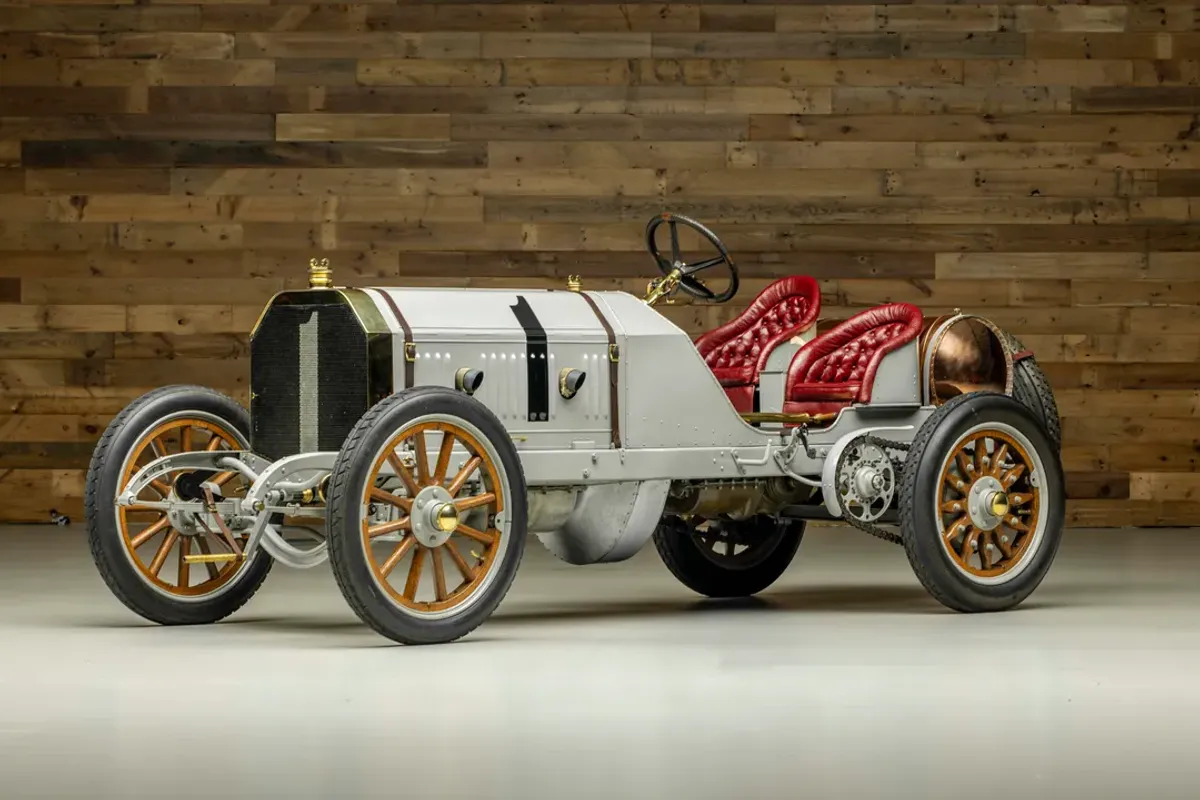
Using much of this remarkable collection of original material, the current owner began reassembling this long-lost companion Vanderbilt Cup racer. Chassis components needed were sourced and used to house a significant and massive Locomobile 16.2-liter (990-cubic-inch) F-head racing engine, a truly remarkable and imposing power plant with a bore and stroke of 7.25" x 6.75". The reassembled car also incorporates numerous original racing-specific components, including the dashboard, steering wheel, gauges, Michelin quick-change wheel equipment, chassis elements, and mechanical hardware directly traced to the original factory racing inventory.
As with many early competition automobiles, the body and select mechanical elements required careful recreation during the restoration and reassembly process. However, the preservation and restoration of the original Vanderbilt Cup Team components retained, combined with the well-documented chain of custody through the Riker family, Peter Helck, and the current owner, firmly establishes this machine as a compelling and historically important American racing automobile of the Brass Era with extraordinary DNA directly linked to Locomobile’s historic one-three finish at the 1908 Vanderbilt Cup. This Locomobile and the factory team's two-car effort is also noted by automotive historian, senior writer and editor, Steven Rossi, in a 15-page feature in the AACA’s 2023 fall magazine, Antique Automobile.
Today, this historically significant creation represents the reunification of one of America’s earliest and most significant factory racing efforts, documenting and reconnecting the surviving pieces of the famed two-car Locomobile Vanderbilt Cup Team that helped establish American credibility on the international stage. Few automobiles better embody the pioneering spirit, engineering ambition, and racing heritage of the formative years of American motoring.
Multiple Vintage Photo provided by VanderbiltCupRaces.com.