










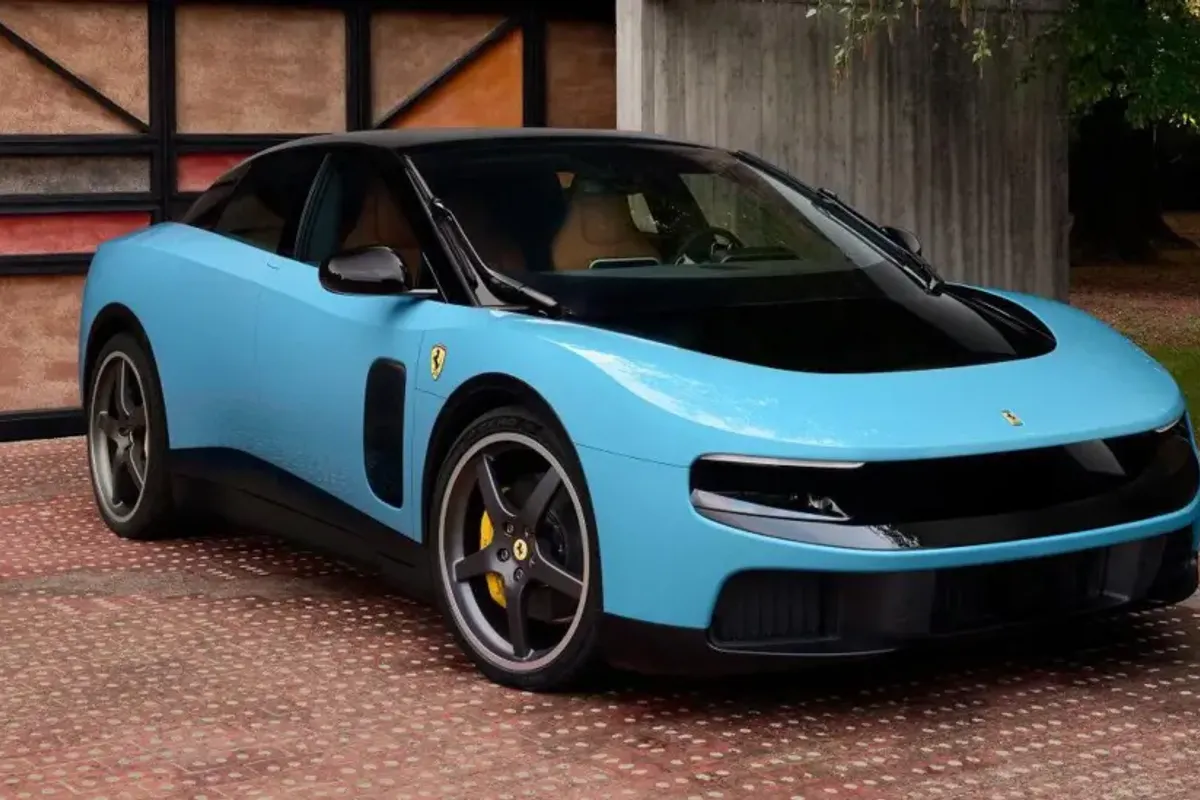
The highly anticipated, next-generation sports car from the Maranello marque has been unveiled, opening a new chapter in the history of the Prancing Horse.
The dedicated platform with four electric engines and the high degree of system integration ensure performance typical of the brand, as well as a level of user-friendliness unprecedented in a Ferrari.
Designed with Sir Jony Ive and Marc Newson at the creative collective LoveFrom, a singular design language unites the exterior, interior and interface with clarity and refined simplicity throughout.
The form is defined by the glass house, an uncompromised, shell-like form. Floating front and rear aerodynamic wings drive aerodynamics and performance.
In one of many automotive firsts, four electric-traction engines with electrically-controlled active suspension and four-wheel steering system all work in perfect synchrony.
Advanced dynamic management, new regeneration and torque management systems, and an authentic, functional sound ensure total engagement and repeatability in every driving situation.
Deeply engaging tactile controls employ the best characteristics of physical and digital, combining beautiful mechanical buttons, switches and dials with contextually relevant digital information.
The car broadens the Ferrari range alongside the existing powertrains and makes it possible to create a completely new kind of Ferrari – something only achievable thanks to the all-electric architecture. Electrification also opens up new design opportunities beyond the car itself.
Ferrari has unveiled the Ferrari Luce in the symbolic setting of the Vela di Calatrava – Città dello Sport in Rome, a venue chosen to mark the beginning of a new chapter in Ferrari's storied history of engineering excellence and innovation. Ferrari won its first ever victory in Rome on this day in 1947, with the Ferrari 125 S winning the Gran Premio di Roma at the Baths of Caracalla circuit. On that decisive day, driver Franco Cortese set in motion an unimaginable legend of success. Some 79 years later, Ferrari returns to unveil a project that reinforces its unwavering commitment to redefine the limits of what is possible.
The Ferrari Luce marks the culmination of Maranello’s multi-energy strategy, announced at the 2022 Capital Markets Day and subsequently confirmed on various occasions. In accordance with the principle of technological neutrality, electrification is just one of the means available to Ferrari to expand its design potential in product architecture, performance, design, and driving experience, without replacing existing engines.
Deepening the Prancing Horse’s in-house expertise in electric technology opens new potential for performance and efficiency across the entire Ferrari ecosystem. This includes technology transfer between road cars and the 499P that triumphed in the last edition of the World Endurance Championship, and the bold Ferrari Hypersail project, a unique laboratory of research and innovation. Ferrari Luce expands the Maranello marque’s expertise still further, opening up a new segment consistent with Maranello’s DNA of combining performance, engagement and versatility.
The Ferrari Luce name evokes clarity and direction. It lights the way towards the future and defines the intent to create a Ferrari 360°, not merely the “electric Ferrari” but an entirely new Ferrari, designed for deeper engagement and performance, with a unique and recognisable character. In keeping with tradition, Ferrari chosen to engineer, develop and manufacture the main components in-house; from the electric engines to the battery pack, every element is created in Maranello to guarantee quality, control and uniqueness. The project includes more than 60 new patents, testifying to Ferrari’s technical excellence and to a vision that also looks to long-term value. In the future, Ferrari will provide assistance on all electric components, including batteries, in line with the Ferrari Forever philosophy.
The design of the Ferrari Luce was entrusted to LoveFrom, the design collective led by Sir Jony Ive and Marc Newson. Introducing a team from outside the Ferrari Design Studio led by Flavio Manzoni invited a new perspective and cross-fertilisation, enabling a new design language to be introduced. LoveFrom was given the creative freedom needed to define the design direction of the project from the outset, translating this design language into an authentic Ferrari experience. The electric power source, Ferrari-engineered engines and advanced drivetrain affords a radically new architecture that uniquely combines extraordinary Ferrari performance with the luxury of spaciousness.
This architecture generously accommodates four doors and five seats, which is a first for the Prancing Horse (as transaxle configurations with a front-mid engine and a rear gearbox do not allow for a fifth seat). The interior is a celebration of hundreds of discrete products, each meticulously considered and treated with individual care. Together they create a single, clean volume, with forms simplified and rationalised in service of the driving experience. The exterior, interior and interface share a unified design language.
A defining visual characteristic of the Ferrari Luce is the unprecedented purity of the glass house. This uncompromised, shell-like form extends below the belt line to the extremes of the car. The front and rear aerodynamic wings, floating above and around the silhouette of the glass house, enable this uniquely pure and simple form. The front and rear light panels are transparent and part of the primary surfaces. The lights seem to gently recede when switched off, preserving the purity of the form. The halo tail lights celebrate the beauty and clarity of the 360 Modena and 458 Italia. The extreme innovation of the Ferrari Luce is manifest with a custom wheel design. Luce has the largest staggered wheel diameters on a series-production Ferrari road car: 23” in the front and 24” at the rear.
The interface is designed with clear organisational principles of input and output. Controls and displays are grouped functionally, with the most essential commands and feedback directly in front of the driver. Thousands of deeply considered details unite to create a singular driving experience. Precision-engineered mechanical buttons, dials, toggles and switches are combined with multifunctional digital displays developed with Samsung Display©. Materials are honest and pure – recycled anodised aluminium, Corning® Gorilla® Glass and premium leather. The superior audio system has 21 speakers and 24 channel/3000 W amplification incorporates the innovative Ferrari Audio Signature, and features presets, individual listening optimisation, and dynamic compensation functions.
From a technical perspective, the Ferrari Luce is based on a bespoke platform with a dedicated chassis and engineering innovations in every single component. Technologies derived from Ferrari’s unrivalled experience in the world of motor racing made it possible to contain kerb weight at 2260 kg, helping deliver best‑in‑class performance (0–100 km/h in 2.5 seconds, 0–200 km/h in 6.8 seconds, top speed over 310 km/h and maximum total power output of 1050 cv) and a range in excess of 530 km.
The car is powered by four electric engines, one per wheel, and is equipped with a high‑capacity 122 kWh battery, an active suspension system derived from the F80 and an independently steering rear axle. Within this framework of technological innovation, two concepts best encapsulate Ferrari Luce’s ambitious entry into the world of high‑performance electric sports cars: the control of each wheel’s motion in every direction and in any dynamic condition, and the authentic approach to sound.
Each wheel is equipped with one actuator for traction and regeneration, one for the steering angle and one to control vertical movement. The ability to adapt torque distribution in real time to road conditions and desired performance provides exceptional freedom and precision of control. Each of the Ferrari Luce’s wheels is therefore perfectly attuned to the driver’s input, allowing the driver to experience a single, fluid movement. Torque vectoring and the elastic balance of the suspension system also assist in changing direction, enhancing the car’s agility and ease of driving.
The Ferrari Luce’s approach to sound is based on the key principle that it must be authentic and functional, generated from the car’s mechanics and serving the driving experience. A precision accelerometer at the centre of the axle captures the dynamic texture and vibration of the rotating components while the sound waves are moving. Developed in-house and patented, this system filters, equalises and amplifies the signal in a similar way to an electric guitar, but only when functional to the driving experience. The sound level is based on the position of the e-Manettino and the use of the paddles, allowing the driver to switch from quiet focus to maximum expressiveness. Sound is emitted via an external amplification system that creates a natural sound wave, and an internal system that ensures detail and high fidelity. As well as the quality of the interior sound, this has the benefit of being audible outside the car. The Ferrari Luce has benefited from cutting-edge noise, vibration and harshness (NVH) research, making it the most comfortable Ferrari ever. Road noise is significantly reduced by the first elastically-mounted subframe in Maranello’s history, as well as active suspension, the optimisation of weight, rigidity, and soundproofing.
The Ferrari Luce succeeds in its ambitious goal of achieving by far the lowest drag coefficient in the history of Maranello’s road cars, paired with an unrivalled interior space. An extreme care for aerodynamics shaped the fundamental architecture of the entire car. Surfaces have been refined to be smooth, continuous and uninterrupted to maximise airflow and wake management. The active aerodynamic grilles are another first for Ferrari, regulating the airflow through the heat exchangers and always ensuring the correct balance between cooling requirements and aerodynamic drag. Active ride height can lower the front by 10 mm at speed to maximise efficiency without compromising comfort or performance. The cooling system is part of an integrated software that optimizes range by balancing power consumption and intelligent warm-up, fast-charging management, and battery and cabin preconditioning functions, operable remotely.
Vehicle dynamics have been developed to exploit the unprecedented advantages of the electric architecture in terms of centre of gravity, inertia, and freedom of control, allowing the Ferrari Luce to maintain dynamic behaviour that is always agile and natural. The driver manages the car via the e-Manettino, which modulates power and traction, and the iconic five-position Manettino equipped with logics that adapt to grip conditions. The Vehicle Control Unit (VCU) makes its debut on the Ferrari Luce; this control centre integrates powertrain and dynamics, updating targets 200 times per second and coordinating efficiency strategies with the brand-new Side Slip Control X.
The electric all-wheel drive is a first for a Ferrari. It allows the full potential of torque vectoring to always make the car precise and responsive, while the new torque shift engagement and extended regenerative braking deliver a progression of torque and engine braking worthy of a sports car. Torque management is a characteristically Ferrari response to one of the typical challenges of electric powertrains: the sensation of strong, instantaneous longitudinal acceleration, which can even be unsettling when pulling away and which levels off as acceleration increases. Ferrari has engineered a proprietary, patented system that allows the available torque to be increased by operating the right-hand steering wheel paddle, whilst maintaining the sensation of progressive acceleration. The left paddle increases energy recovery and the sensation of deceleration, delivering a dynamic experience unrivalled by any other car in its class.
The powertrain comprises four F80-derived permanent magnet synchronous engines with radial flux, delivering a maximum speed of 30,000 rpm at the front and 25,500 rpm at the rear. The system operates on 800 V architecture and combines performance with efficiency, with solutions directly derived from motorsport. The high-voltage battery pack was designed, validated, and built in Maranello and comprises 210 cells in series that deliver 122 kWh and support fast charging up to 350 kW. It is designed as a structural element of the car. Power electronics feature compact inverters and a DC/DC resonant converter for the active suspension to achieve record-breaking efficiency of more than 98%.
The Ferrari Luce’s battery pack, chassis and body form an integrated system capable of optimising structural performance and efficiency. The chassis combines hollow castings, extrusions, and aluminium, while the body utilises extrusions and aluminium sheet metal. The architecture maximises interior space, eliminating the central tunnel and integrating the battery beneath the floor and rear seats. The high level of optimisation and integration of an elastically mounted rear subframe combines the handling typical of a Ferrari with superior performance in terms of driving comfort. The battery housing actively contributes to rigidity, with an increase of over 25% (bending) and 35% (torsional) compared to previous four-door models. The BIW-battery housing combination is among the lightest in its class for a vehicle of this specification. The semi-virtual double wishbone suspension (with high-mounted upper arm), independent rear-wheel steering, optimised CCM brakes, and targeted solutions to reduce friction, complete a set-up designed to maximise driving excitement and comfort.
The extensive use of recycled secondary-alloy aluminium allows a reduction in CO₂e emissions during production of around 70% of the overall vehicle weight.
The Ferrari Luce marks a new chapter, yet one that continues its long history of uncompromising innovation, driving performance, and an engineering culture that seeks to redefine the limits of what is possible.