







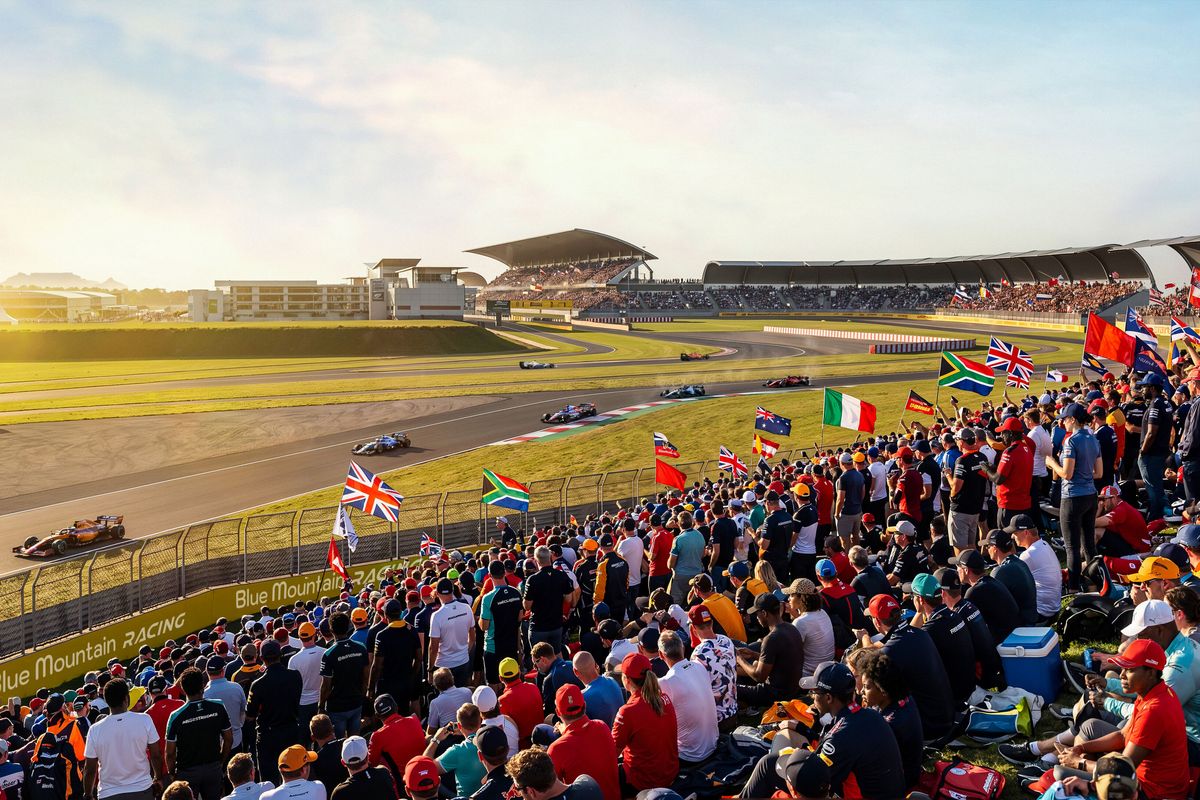
Image: Artist's impression of the proposed Blue Mountain Racing development
Blue Mountain Racing (BMR) has formally announced its intention to build a new FIA Grade 1 and FIM Grade A circuit outside Cape Town and to host an inaugural South African Grand Prix there in 2031, returning Formula 1 to the only continent currently without a race. The 600-hectare site, in the scenic Swartland area north of the city, was secured in April 2026. The project is being advanced as an entirely privately funded venture by a group of prominent South African business leaders and international motorsport professionals.
South Africa last hosted a Grand Prix in 1993 at Kyalami racetrack, outside of Johannesburg. BMR’s plans focus on Cape Town, one of the most recognisable city brands on the planet and consistently ranks among the world's top travel destinations. Formula 1 performs at its best when the city hosting it already has a global reputation that people want to experience. Miami, Singapore, and Las Vegas hold their places on that calendar as much for the cities as for the racing. Cape Town is a vibrant African city, renowned for the varied experiences it offers world travellers. Its natural beauty, rich heritage and cosmopolitan charm – from its pristine beaches to the Cape Winelands – make it a truly unique destination.
BMR’s vision has the potential to unlock substantial public benefits, including tourism growth, job creation, skills development, investment attraction and broader economic activity for local communities, the region and South Africa as a whole. The project has received extensive interest and in-principle support from a number of major South African companies who see this as an opportunity for catalytic economic development and showcasing South Africa on one of the biggest global platforms.
Cape Town and the Western Cape have demonstrated their capacity to host major international sporting events at the highest standard across a variety of sporting codes, including hosting the largest timed cycling race in the world each year – the Cape Argus – as well as this year becoming the newest home to the Abbott World Marathon Majors, the first in Africa. It was also a major host city for the 2010 FIFA World Cup and regularly welcomes large crowds for international rugby, cricket, and soccer matches.
It is also lauded for its music and party culture, hosting global DJs at major events and festivals every year – including most recently John Summit, Keinemusik, and Black Coffee’s own weekender, which hosted Berlin-based DJ Peggy Gou alongside him. Other major DJs have held residencies at Cape Town’s beach clubs and have made appearances at other clubs, including Ibiza-based Pacha, which has hosted pop-up events in Cape Town for a number of years.
Europe remains Formula 1's largest television market by audience, sponsorship value, and broadcast revenue, and Cape Town sits within two hours of Central European Time. A qualifying session at midday on a Saturday is live in prime time across the major European markets, and a Sunday race broadcasts into living rooms in Britain, France, Germany, Italy and the Netherlands at peak viewing hours.
"Cape Town is served by a large international airport with direct connections to Europe, the United States and the Gulf, and a nearby port for cruise liners. It offers world-class hospitality and is set against a backdrop of the iconic Table Mountain, the peninsula’s stunning beaches, and its nearby winelands. These are assets that no circuit designer could ever manufacture," Said Froneman.
The circuit is being designed to FIA Grade 1 standards from the outset: between 4.5 and 5.5 kilometres, a 600-metre pit straight, a full-throttle kilometre run, and natural elevation change built into the layout rather than engineered around it. Building on open ground outside the city was a deliberate choice, as a permanent venue gives designers the length, width, elevation and run-off a street circuit cannot and avoids the months of civic disruption and public cost that temporary city circuits impose.
The team behind the proposal is headed by Neal Froneman, who was the founding chief executive of Sibanye-Stillwater, which he built into one of the world's largest precious metals producers, employing some 75,000 people. He is the former chair of the World Gold Council. BMR's chief executive, Bobby Hartslief, has spent more than four decades in international motorsport, including the management and promotion of Formula One Grand Prix and MotoGP World Championship events.
The track will be the first component of a precinct planned to operate year-round: conference facilities, an amphitheatre, a 50-hectare waterfront, a mixed-use commercial precinct, hotels and residential units. It will also become an automotive hub with research and technology facilities for manufacturers and teams, a driving academy, an automotive skills development programme, and a karting pathway for young people from the surrounding areas.
With the site secured, BMR is now engaging Formula 1 and MotoGP's commercial and sporting authorities while rezoning, environmental assessment and design finalisation run through 2028. Construction is programmed to commence in 2029, with FIA and FIM homologation and proving events from early 2030, ahead of an inaugural Grand Prix in 2031. BMR continues to engage commercial, financial and strategic partners as the project develops.
Africa is home to more than 1.4 billion people and some of the world's most passionate sporting fans, and it is the only inhabited continent without a place on the Formula 1 calendar. With Cape Town ready and the site secured, South Africa extends a warm and open invitation to Formula 1: come race in Africa, where the next great chapter of the sport's global story is waiting to be written.