










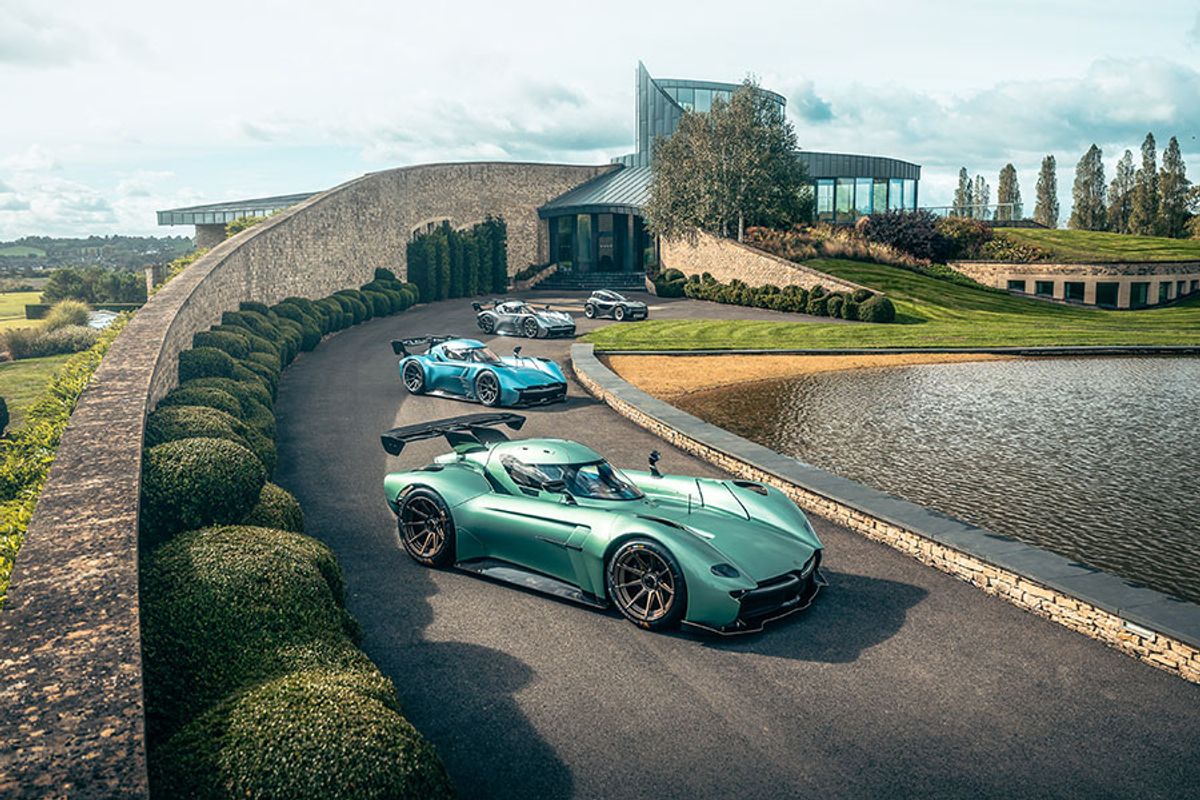
McMurtry Automotive reaches double digits after a decade that saw a tiny team of talented engineers in rural Gloucestershire, England, expand to become the manufacturer of one of the highest-performing track cars ever made: the Spéirling PURE.
To celebrate this milestone, McMurtry has released a new film to showcase many of the highlights captured on film over the past ten years, as well as tell the story from the point of origin.
Please enjoy it Click here for the video
Today, based in a brand-new production facility in the Cotswolds, England, McMurtry is ready to embark on a second decade as it scales up to produce the Spéirling PURE for customers around the globe.
Now also with an applied technology arm - McMurtry Technology - the company is working hand-in-hand with blue-chip automotive and motorsport OEMs to supply its proprietary battery and Downforce on DemandTM technologies.
McMurtry first captured global attention in 2022 when a Spéirling prototype set a new Goodwood Festival of Speed Hillclimb record - beating many established manufacturers before it. In 2025, another Spéirling prototype shattered the Top Gear Test Track record, once held by the 2004 Renault F1 car. That same year, the car broke new ground to become the first car to ever drive upside down.
Thomas Yates, McMurtry’s co-founder and Managing Director, comments: “Just ten years ago, there was only a handful of us, with a blank sheet of paper and the ambition to build a car company. Since then, we've patented revolutionary new technologies, brought together a world-class team of nearly 100 people, and raised the bar for what a performance vehicle can do with the Spéirling. It's been an incredible decade, but the next ten years will be even more exciting.."
Origin story
It was Sir David McMurtry - the late engineering pioneer - who first came to Thomas Yates with a proposition to build a car company in 2015.
Sir David's own story began in the 1970s at Rolls-Royce, where he was the youngest-ever Deputy Chief Engineer on Concorde's Olympus engines. The tiny fuel pipes inside the engines needed to be measured to an extraordinary degree of accuracy, and no tool existed that could do the job. So he invented one: the touch-trigger probe, which precisely measures the spatial coordinates of components, to hundredths of a millimetre.
Sir David patented and commercialised his invention, and with his colleague, John Deer, founded Renishaw plc, now one of Britain's leading engineering companies. Today, the touch-trigger probe is used by manufacturers worldwide, and almost every vehicle, aircraft, train or rocket produced has had parts measured by one.
Fast-forward to 2015, and Sir David began to convince Thomas to leave his position at Mercedes AMG HPP in Formula 1, together with his best friend and now McMurtry Technical Director, Kevin Ukoko-Rongione.
In 2016, Sir David, Thomas and Kevin, in a team totalling six engineers, set out to create the ultimate small, lightweight driver's car. The result was ‘D01’: a superbike on four wheels, with a tiny wheelbase, a weight of 660kg, 400hp, all-wheel drive, a 40kWh battery and a bespoke carbon-fibre chassis plus bodywork. It drove like nothing else on the road, and Sir David was delighted.
But commercially, the project didn't add up, and the team had to change direction quickly. The challenge was to create a car that remained small and lightweight, yet was even more capable: enough to outperform an F1 car, to truly capture hearts and minds, and ultimately earn its place in the hypercar market. Sitting in his office with Thomas one day, Sir David offered a simple suggestion: "Ah, just suck it to the ground!"
The idea had a basis in history. In 1970, the Chaparral 2J Can-Am racer used a second engine to spin two large fans at its rear, sucking the car to the track. In 1978, Brabham tried again in Formula 1. The BT46B won the Swedish Grand Prix on its debut, but was withdrawn immediately afterwards and never raced again.
Between 2018 and 2021, McMurtry took the concept of fan-based downforce and re-engineered it for the 21st century. The result was the Spéirling prototype - an electric fan car capable of generating up to 2,000kg of downforce from a standstill, with acceleration to match, and which went on to take the Goodwood Festival of Speed Hillclimb record in 2022.
Following that success, the team developed the platform further, and the Spéirling PURE prototype was born, designed with customers in mind. At Dunsfold, with The Stig at the wheel, it set a new Top Gear Test Track lap record. Shortly afterwards, it became the first car ever to drive upside down with Thomas at the wheel.
Today, after thousands of kilometres of testing, McMurtry is producing the Spéirling PURE for customers around the world.
Ten-year timeline:
2016
McMurtry Automotive is founded
Development of first McMurtry prototype vehicle begins
2018
First McMurtry prototype vehicle - D01 - is completed
Fan downforce research and development begins
2021
Spéirling prototype is unveiled to the world
2022
Spéirling prototype sets the unbeaten Goodwood Festival of Speed Hillclimb record
2023 - 2024
Expanded prototype development and customer test-drive programme around the world, setting records at Hockenheim, Castle Combe and Laguna Seca
2025
McMurtry Technology arm is launched
Spéirling PURE prototype sets the unbeaten Top Gear lap record
Spéirling PURE prototype becomes the first car to ever drive upside down
2026
First McMurtry Owners Club event
New McMurtry factory opens in the Cotswolds, England
Spéirling PURE production car is unveiled
Spéirling PURE enters production
Click here for the McMurtry Midwest website by Racecar