












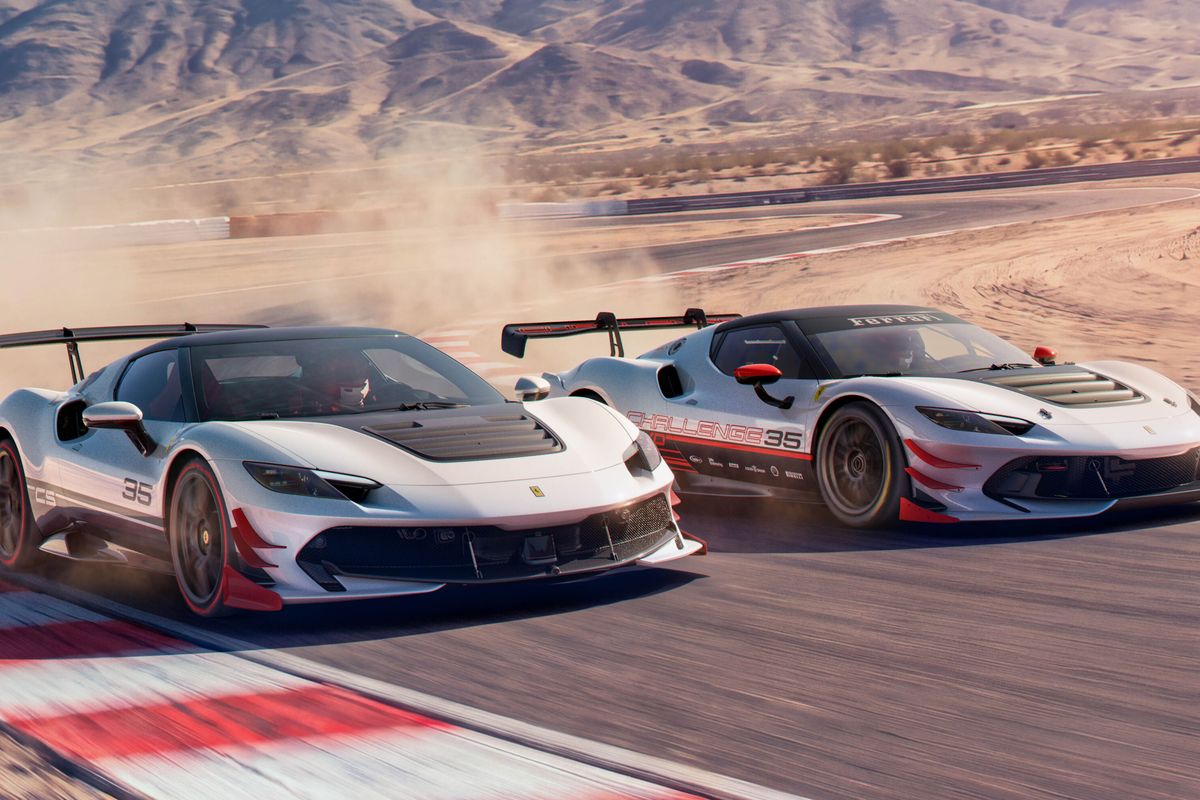
The 296 Challenge Stradale is the Ferrari in the current range that can offer the most direct link to a race car; the 296 Challenge EVO sets the performance benchmark for the Ferrari Challenge with an eye towards 2027.
The cars are powered by a 120° twin-turbo V6 without hybrid assistance, capable of delivering 670 hp (296 Challenge Stradale) and 700 hp (296 Challenge EVO).
The 296 Challenge Stradale generates 617 kg of downforce at 250 km/h; the 296 Challenge EVO increases maximum downforce by 12% and reduces drag by 4% in the Low Drag configuration compared with the previous version.
The cars share a design philosophy focused on maximising precision, stability, and consistency of performance, without compromise.
On the 296 Challenge Stradale, this approach results in a more stripped-back, direct, and physical driving experience, while on the 296 Challenge EVO, it is tailored to maximise performance in Ferrari Challenge races.
Their joint unveiling at the Ferrari Finali Mondiali highlights the continuity between the Ferrari Challenge, racing development, and road cars.
Ferrari today unveiled the 296 Challenge Stradale and 296 Challenge EVO, two new cars developed in close collaboration to highlight the symbiotic bond between the Prancing Horse’s race cars and production cars, as well as the exceptionally high level of technology transfer that sets them apart. The 296 Challenge EVO builds on the car that redefined the standards of the Ferrari Challenge and will make its debut in the 2027 season, while the 296 Challenge Stradale brings the technical essence and pursuit of uncompromising performance to a road-legal vehicle.
The cars were unveiled during the 2026 Ferrari Finali Mondiali, held at the Circuit de Barcelona-Catalunya in Montmeló. The final event of the Prancing Horse’s racing season brings together, on the same track, the Ferrari Challenge, programmes dedicated to competition cars and non-competitive activities.
The 296 Challenge Stradale is the Ferrari currently in the range that can offer the most direct link to a race car. The car is indeed stripped-back, almost clinical in its setup, entirely geared towards providing the driver with a direct and physical driving experience. Performance, consistency, and repeatability of driving characteristics thus become the defining characteristics of its dynamic setup.
The 296 Challenge EVO, on the other hand, builds on the strengths of the 296 Challenge with the aim of boosting absolute performance without compromising driveability and consistency. The versatile aerodynamic package, improved dynamic controls, and wider operating range make the car faster, more predictable, and more consistent, bringing the driving experience even closer to that of the 296 GT3 Evo.
Both feature the 2,992 cc 120° Ferrari twin-turbo V6 engine in the exclusively internal-combustion configuration of the 296 Speciale, which has received numerous accolades and rewritten lap records at circuits throughout Europe. In the 296 Challenge Stradale, it develops 670 hp at 8,000 rpm and is paired with an eight-speed dual-clutch F1 transmission; in the 296 Challenge EVO, it instead delivers 700 hp at 7,500 rpm, with a specific output of 234 hp/l and a seven-speed F1 transmission. The absence of a hybrid component limits the car’s weight and complexity, further underscoring the direct connection between driver and accelerator, engine, and rear wheels.
The 296 Challenge Stradale has a dry weight of 1,330 kg, a full 140 kg less than the 296 GTB, and boasts a weight-to-power ratio of 1.98 kg/hp. The 296 Challenge EVO shares the same weight, underscoring the fact that both cars have been designed with a focus on lightweight construction and performance.
This approach is also evident in the design. The volumes and surfaces of the 296 Challenge Stradale have been stripped of superfluous elements to reduce the car’s visual mass and make its technical functions more readily apparent. The result is a deliberately more essential and racing-inspired design language, in which every element serves a purpose and helps distinguish it from the other berlinettas in the range. The car thus retains its visual connection with the 296 Challenge EVO, reinterpreting it in line with the safety, type-approval, and practical requirements specific to a road car.
Aerodynamics represent one of the principal points of contact between the two cars: the 296 Challenge Stradale generates 617 kg of downforce at 250 km/h, 72% more than the 296 GTB, through an integrated system comprising a fixed rear wing, splitter, flick, aero damper, vortex generators, and a fully enclosed underbody.
The 296 Challenge EVO increases maximum downforce by 12% compared with the 296 Challenge, equivalent to an additional 100 kg at 250 km/h, and introduces the Low Drag configuration, which reduces minimum drag by 4%. The difference in aerodynamic load between the High Downforce and Low Drag setups has more than doubled. The wider wing adjustment range, the Low Drag kit, the redesigned rear diffuser, the new mirrors, and the carbon-fibre components extend the 296 Challenge EVO’s operating window across different circuits. A high-performance driveshaft with dedicated cooling broadens the component’s operating window under the most demanding conditions. The option to increase rear ride height by up to 10 mm provides approximately 30 kg of additional downforce at 250 km/h.
The vehicle’s dynamics follow the same philosophy of maximising performance. The 296 Challenge Stradale features ABS Evo in all driving conditions and in every Manettino setting, along with specific control systems, a dedicated setup, and Pirelli P Zero R and P Zero Trofeo RS tyres. The 296 Challenge EVO updates its traction-control and electronic-differential control strategies to improve combined performance, braking stability, and agility through high-speed corners; the new brake-pedal curve also increases modulation, travel, and pedal load at the same level of deceleration.
The 296 Challenge EVO improves consistency over race distances and reduces tyre degradation. In comparative testing, the car proved faster on the circuits analysed, with an improvement of 0.8 seconds at Mugello compared with the 296 Challenge. The redesigned instrument cluster makes driving information, control intervention levels, TPMS data and lap times easier to read.
These features are particularly significant in the run-up to 2027, when the Ferrari Challenge will introduce three rounds featuring 40-minute Endurance races, beginning with the second event of the season at Mugello, which will mark the debut of the new format.