









Estimate: EUR 3,500,000 – EUR 6,000,000
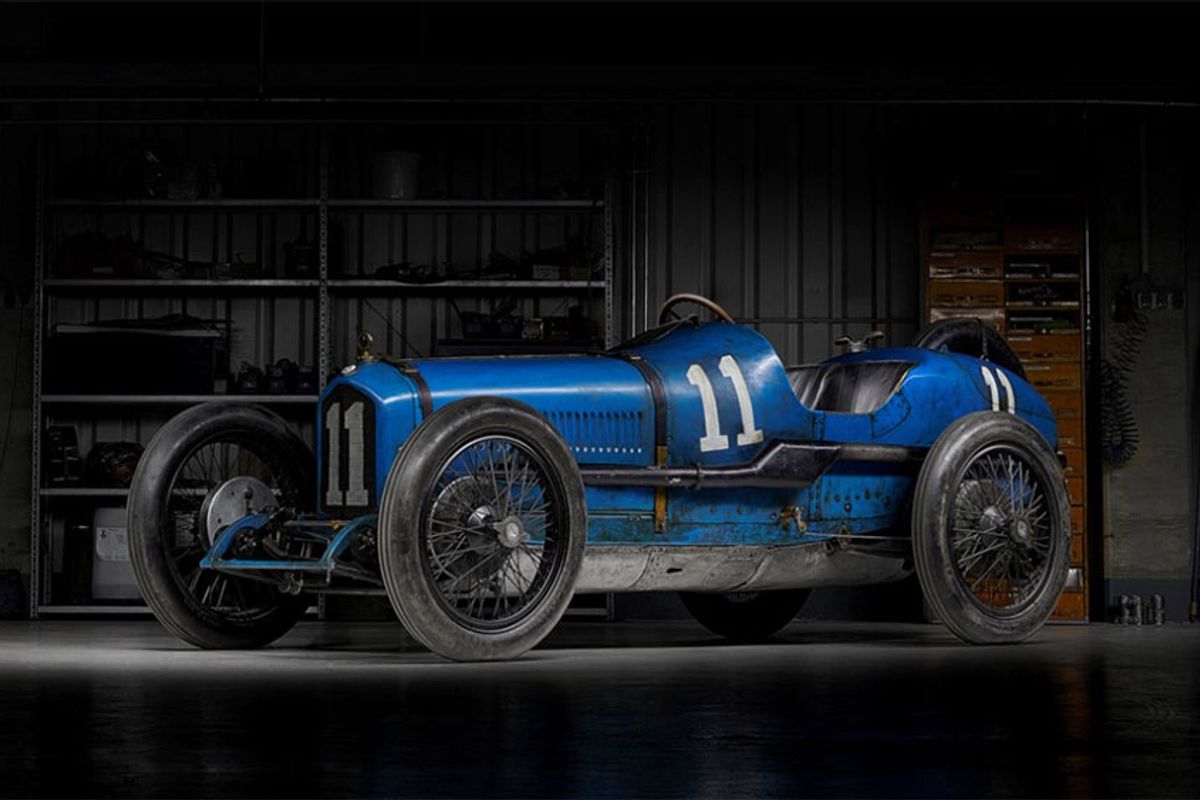
1920 BALLOT 3 / 8 LC GRAND PRIX TWO-SEATER @ Christie's Rétromobile Paris Auction
Estimate: EUR 3,500,000 – EUR 6,000,000
CHASSIS NO. 1006
ENGINE NO. 1006
HIGHLIGHTS
Pioneering Icon of Race Engineering Technology
Legendary Double Overhead Cam Race Car Penned by Ernest Henry
Believed to Be the 1921 Italian Grand Prix Winner, French Grand Prix Entrant, and Two-Time Indianapolis 500 Entry
Acknowledged as the Most Original of the Three Surviving Examples of The Model
Extensively Documented with Known History from New
SPECIFICATIONS
2,970 CC DOHC Inline 8-Cylinder Engine
Twin Zenith Carburetors
108 HP at 3,800 RPM
4-Speed Manual Gearbox
4-Wheel Cable-Operated Drum Brakes
Front and Rear Leaf-Spring Suspension
The story of “Les Charlatans” is one of the most fascinating tales of engineering in the history of the automobile – and arguably the most influential. Funded by Robert Peugeot in a covert “skunk works” operation, two of his top drivers, Jules Goux and Georges Boillot, collaborated with designer Paolo Zuccarelli, who had recently joined from Hispano-Suiza, and engineer Ernest Henry to build an all-new racing machine. The result was the first engine to combine twin camshafts, four valves per cylinder, and hemispherical heads in a four-cylinder powerplant. It revolutionized racing in that period and ultimately impacted nearly all high-speed competition engines from that day forward. Surviving original examples of Henry’s work are extremely rare, and this example is one of them.
In 1919, only days after the WWI armistice was signed, the US announced that racing would recommence at Indianapolis that summer, comfortably ahead of anything in Europe. Seeing an opportunity, Frenchman René Thomas convinced engine manufacturer Ernest-Maurice Ballot, who had made a considerable fortune supplying engines for the war effort, to build a complete car that would make his mark in racing. Ballot turned to the prewar genius Henry and commissioned an all-new racer for the regulated five-liter category. Henry drew extensively on his earlier twin-cam designs for the new car, but configured the engine with eight cylinders and hemispherical cylinder heads, for a claimed output of 150 bhp.
Subsequently, US and European authorities decreed that the formula would thereafter be reduced to three liters. This sent Henry back to the drawing board to develop an evolved Ballot, placing additional focus on overall aerodynamics with a carefully tapered, wind-cheating body and a spare wheel mounted vertically in the tail. Contemporary research suggests that four cars were built in total.
At the 1920 Indianapolis 500, three new Ballots were fielded by René Thomas, Ralph DePalma, and Jean Chassagne. They were by far the fastest cars in the field, with DePalma qualifying on pole and leading the race for 465 of the 500 miles before a fire and resulting loss of fuel placed him back in 5th – behind Thomas and trailed by Chassagne in 7th.
A sole Ballot, driven again by DePalma, returned to Indy in 1921, where once more it set the pace; however, a broken connecting rod brought its race to an end after 200 miles.
At the French Grand Prix in June 1921, the blue 3/8s dueled with the American Duesenbergs for many hours – and are often depicted running close behind in paintings and photographs commemorating Jimmy Murphy’s ultimate win. In fact, Chassagne’s Ballot exchanged the lead for many laps ahead of Murphy, before succumbing to damage to the fuel tank. DePalma finished in 2nd place and Goux, in a new 1922 formula two-liter car, secured 3rd.
The three-liter Ballot’s finest hour came at the 1921 Italian Grand Prix in Brescia, where, on the long triangular circuit, a race strategy of tire preservation and fuel economy was easily managed, as these cars were lighter than their competitors and more nimble in the turns. Charlatan Jules Goux, in the No. 11 Ballot, was the first to cross the finish line. Its victory on Pirelli tires was proudly splashed across the press by the manufacturer, which highlighted the car’s average speed – a staggering 144 kph.
In 1922 at Indianapolis, two Ballots were fielded – most likely the same cars that had run in Italy – driven by Jules Goux and Eddie Hearn. While the Brickyard proved too punishing for Goux’s car, which suffered a broken back axle, Hearn posted a very respectable 3rd place.
At this time, as with many of the era’s greatest race cars, the introduction of the new two-liter formula rendered the Ballots obsolete in international racing, and the three-liter team was dispersed.
The ex-Works history of chassis 1006 is easily traced, as it was the sole example sold to the UK. Its first owner in the UK was famed racer and car dealer Malcolm Campbell, who purchased it in February 1923, and was active with it at Brooklands later that year. Additionally, he painted it in his signature Saxe Blue, making it one of his earliest “Bluebird” cars. In 1927, Campbell advertised the car for sale and it was purchased by famed “Bentley Boy” Jack Dunfee, who continued Campbell’s racing legacy, starting some 38 races over the following six years and achieving 11 wins along with numerous additional podium finishes.
In 1933, the car was acquired by one of the leading female drivers of the day, Australian Joan Richmond, but when it threw a rod through the side of its crankcase – the repair of which is still evident today – she passed the car on. Throughout its Brooklands years, timeless images capture this Ballot on the banking alongside the Birkin Bentley and other icons of the period.
Captain Dennis Shipwright became 1006’s next custodian and worked to improve its lubrication before passing it on to noted Vintage Sports Car Club pioneer Cecil Clutton and R. Watkins-Pitchford. They retained the Ballot until 1940, when it was acquired by Michael Crowley-Milling. Despite the best intentions, a return to the road was never accomplished.
In 1970, Michael Crowley-Milling’s nephew, Humphrey, acquired the Ballot from his uncle with the goal of returning it to the road. His endeavors were extensive, liaising with a variety of engineering firms in the UK, until in 1977, the Ballot was back to running condition and registered for the road as “XN 7845.” Humphrey Milling kept the car until his death in 2014, and following a brief spell of ownership in a UK collection, 1006 was purchased by the current owner in 2016.
A passionate enthusiast, the current owner began fastidiously researching the 3⁄8 Ballots with the aim of restoring the car as accurately as possible. While all three examples were extant, the opening salvos of their histories had remained largely speculative for nearly 100 years. To decipher and attribute specific races, the owner amassed as much material as possible, analyzing, scanning, and enlarging each known image. Although unquestionably precision-engineered identically, being hand-built automobiles – with body panels rolled, cut, and riveted, and tailored to their drivers and riding mechanics – some clear differences between the cars began to reveal themselves.
On account of the tight seating arrangement, the mechanics were forced to extend their right arms around the driver to hold onto a cutout “handle.” As the mechanics varied in size and arm length, the locating hole fell at a different point on the driver’s side of the bodywork. It is through this and other detailed features – carefully researched by the owner – that he attributes 1006 with the following racing history: Indianapolis 500, 1920, Jean Chassagne, No. 26 (7th); French Grand Prix, 1921, Jean Chassagne, No. 8 (retired while leading); Italian Grand Prix, 1921, Jules Goux, No. 11 (1st – Coppa Florio); and Indianapolis 500, 1922, Eddie Hearn, No. 15 (3rd). It should be noted that the owner of car 1007 has also researched the cars considerably, and feels that car 1005 may have been campaigned at Indianapolis in 1920, prior to its accident in France, and that the Italian Grand Prix victor may have been 1007.
At the same time, the restoration was carried out by two respective experts in their fields. The rare and important original eight-cylinder engine was accurately and authentically rebuilt, including a new crankshaft and the discrete inclusion of an oil pump to ensure consistent lubrication.
The remainder of the car was disassembled by Julian Parker and sympathetically rebuilt where necessary. The process was extensively documented by photographs, which can be viewed in the accompanying history file. Many years of paint were removed, and proved to have protected the car’s intrinsic authenticity. The archaeology revealed that most of its components were stamped, and many numbered “2.” Inside the frame, a brush-painted “N2” was found, while the passenger-side front dumb iron is plainly stamped “3⁄8 LC No. 2.”
At Rétromobile in 2019, the fruits of these labors were realized with the unveiling of the restored car, accompanied by a two-volume book on Ballot. Despite this erudite approach to its history, the Ballot has always been regarded primarily for what it was built to do – to be driven. And driven it has been, with an extensive campaign of use at concours and tours around the world, including winning Speed Demons in Villa d’Este in 2017, winning its class in Chantilly in 2019, Hampton Court, and Goodwood Festival of Speed. It has also been welcomed by Pirelli to the start of the 1000 Miglia on numerous occasions, though the stop-and-go traffic and its precursing age prevents actual entry. The 3⁄8 LC has also been featured in an array of publications, including Classic & Sportscar and Octane magazine.
When initially restored, its paint finishes were chosen to evoke the look of a patinated warhorse, wearing the no. 8 of the Grand Prix de l’ACF. Following reactions to the car when on display, however, the aesthetic was toned down, and over the ensuing thousands of miles the car developed its own natural patina. As research continued, and the consignor became ever more convinced of its attribution, it was re-liveried in the winning no. 11 of the Italian Grand Prix. Later, Chassagne’s personal engraved steering wheel was sourced and fitted.
With the other two three-liter 3/8s securely housed – chassis 1008 in the Musée National de l’Automobile in France, and chassis 1007 in a prominent US collection – this example likely represents the only opportunity to acquire one of these groundbreaking cars. Indeed, it may well be the only surviving Henry Twin-Cam to come to market for the foreseeable future.
This Ballot 3⁄8 LC Grand Prix comes to public auction for the first time in its life, copiously researched, supported by extensive documentation, and its importance thoroughly elevated by its truly enthusiastic ownership. Widely regarded to be the best of the three surviving examples from the original four built, it stands as a living, breathing testament to the brilliance of Ernest Henry, and as a profoundly important piece of motor racing history.
*Please note that this vehicle is registered as 38LC1006.