







Report by Anthony Pozner - Hendon Way Motors
Forza Ferrari! Given that the Scuderia Ferrari are, and look like continuing to dominate the Formula One season yet again, it was fitting that this years' Modena Cento Ore Classic started off in the direction of Maranello. We doffed our caps as we sped past the factory gates en-route to Fiorano for a sedately paced 'special stage' round the famous Ferrari test track. An exciting and entirely appropriate start to the event. Mauro Bompani, his wife and assorted Bompani children are principal in organising what has become a standard part of the classic car tour annual calendar. The years are turning into a set pattern of big events with the Tour Auto in France in April, Cento Ore in June and the Tour de Espana in the late Autumn. There are other events, of course, but these three dominate by ensuring a great breadth of eligible cars, sound planning, spectacular scenery and a great mix of hard driving and companionship.
Italy in June is just stunning: from the hills North of Modena down through the plains to Arezzo and then across to the Adriatic coast and finally back, South of Bologna to Modena. Over four warm and balmy days the 110 or so cars (split into broadly two groups: competition and regularity) charged and battled for position and perfection. There were trials along the way and many cars returned home broken and dented but the event was a great success.
Leaving Modena to the South on the afternoon of day one, we shot past the glamorous Hotel Donatello, a landmark that we were to pass several times over the four days, towards a cattle farm! No, not the home of Lamborghini, but a cattle farm called Hombre with a little added extra: an amazing crop of Maseratis stored in a converted barn. Such is the surprise factor of this event. All 200 or so of the entrants were entertained to a wonderful lunch in the farm courtyard surrounded by old tractors, flies and the unmistakable rich smell of cow dung. It was great. The temperature, already in the low 30s meant that people sought the shade from the fierce sun. An interesting Bompani innovation, if that is what it can be called, was to introduce a 'Collectors Section' which, for the first two days of the event only, permitted a spectacular group of racing Lancias and rare road Ferraris (including the fiendish looking Enzo) to join in the fun. The film star set in their late Ferraris posed in the shade of the courtyard trees to protect their immaculate bodywork.
The tiny village of Torre Maina hosted the first closed road special stage. It is at this stage that the competitive drive starts. Now, by Italian sporting rules, unlike the French or Spanish ones, timing in regularity is to the 100ths of seconds. Impossible I hear you cry! but not for Italians, apparently it isn't. The only slight problem with Torre Miana was the timing ground to a halt in those beautiful hilly pastures because there was a wedding taking place. How Italian, how romantic: Ferraris, Maseratis, Lancias, Lamborghinis all beautiful things delayed by a beautiful wedding. The cars steamed and hissed as they waited and waited, the drivers got hotter and hotter until finally we were all allowed up the hill. Timing is critical. An exact time is given for the stage and you amass points for every 100th of a second that you are late or early. An exacting science only possible with intense practice and highly accurate timing and distance equipment.
For the Hendon Way Motors Ferrari 275 GTB/4, a well seasoned competitor, once again sporting Anthony Pozner at the wheel and David Forfar on the books, the game, however seemed well and truly over on the way down the hill climb as it sounded like a wheel bearing had gone. We nursed the car to the next special stage and duly progressed but suffered under the time constraints imposed by the apparently defective bearing. The car made it back to the Piazza Grade, a classic Italian piazza where we frantically sought mechanical assistance. Usually these events are typified by the general willingness of other competitors to help those in need. And, very kind help was at hand in the form of Lincoln Small who valiantly tried to secure us a replacement bearing, but to no avail. As we headed for dinner, day two looked decidedly under threat. No bearing: no drive.
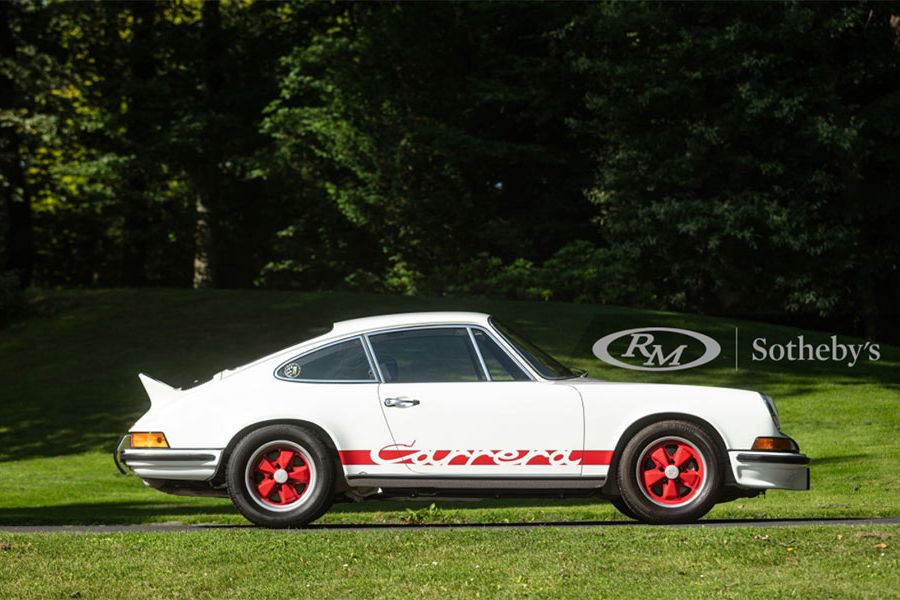
No overall results were produced for day one but is was clear that the usual tussle between Porsche RS/RSRs, GT 40s and the delectable 250 LM was going to be the order of the event. In Regularity the technologically competent Italians were the pick of the field (mostly in Porsches) along with Bob and Anne Linwood in their 2.7 RS Carrera. Day two started from the Piazza Grande in Modena where competitors were timed off at one minute intervals. Our ailing Ferrari headed once again past Donatello bound for Maranello and the Ferrari test track at Fiorano. The residents of Maranello, by now used to seeing wonderful cars on a daily basis were given a rare treat in the form of 75 275 (in all guises) which had gathered from all over the world to celebrate the model's 40th anniversary. Helmut Schnugg, the celebrated photographer and Ferraristi, was granted special permission to photograph some of these 275s directly outside the late Enzo Ferrari's house. Our 275, absent from celebratory duties in the name of sport, was, in the early morning of day two, very definately at a standstill.
You can guess where too: right outside the Factory but it being a Sunday morning, the chapel would have been a more appropriate place to stop. Having tried in vain to source a replacement bearing, we were fortunate to have Harry Leventis's engineer examine the suspect wheel and surrounding structures. After a thorough examination of the offending area, the 275 was declared in fine health with nothing obviously adrift. What was causing the noise, we simply didn't know. Cheered by the positive diagnosis, we left Maranello and the Fiorano track (which the competitors were allowed a sedate drive around) and charged to catch up our place in the field. However we arrived 11 minutes late at the next special stage and that was the event over for us. Having amassed so many penalty points, there was no chance of us recovering. So, the decision was made that we would very thoroughly enjoy ourselves. And that we truly did.
The special stages were spectacular and well chosen by the organisers. This part of Italy, just to the West of Bologna, is stunning, peppered, as it is with castellos and monasteries, vineyards and small towns. People cheered and waved as we sped through. Sometimes on these types of events, when the field gets spread out, it is only the waves of the spectators that give the navigator some comfort that he is still on the route. Lunch was taken at the wonderful Il Postiglione and after a quick stop, we headed to the fantastic Autodromo Mugello. What a setting this was. The circuit, famous for its bike racing events, was a dream for cars too. We arrived in time to watch the competition section complete their races and it was a fascinating site.
There are a few cars of the 1960s and 70s which dominated GT and Le Mans events. The Ford GT 40, the lightweight Jaguar E-type and, of course the Ferarri 250s. It was just like being back in those times again as the GT 40 of Chiles and Mountford battled it out with the Leventis and Hardman 250 LM. It was also great to Michael Cowdray and Rupert Cleavley in CUT 7, that iconic Jaguar low-drag E-type which, with great flair and dedication, Michael continues to campaign. The other contenders were the Group 4 Daytonas of Monteverde and Grist and Sally and Dudley Mason-Styrron. There were, however a couple of odd balls: a Chevron B8, a tiny car with a huge engine was unbelievably fast which even the GT 40 had trouble with that. But, on an altogether different planet was a German entered Porsche 3.0 RSR. The orange car didn't sound flat out on the long Mugello straight, but by lap three it was some 19 seconds ahead of the field. It really was as if it had rocket engine in it. One can only suppose that through the bends the car was as if on rails; very very fast indeed.
When Regularity went out for its session, it was a bit of a lottery. Many entrants will never have been on a track before, do not know the lines or, indeed the capabilities of their cars. This all makes for good fun and much cursing. The game for regularity is to complete 4 timed laps to the exact 10th of a second. Now, given that by Italian rules you are actually allowed to stop on the track so that you arrive over the line on time, this is very difficult and somewhat annoying if your Green lap is a quicker time than others. We managed to get around in Just under 3 minutes, which for a fully laden road car is not a bad effort.From Mugello, the route headed directly South towards Arezzo through some of the most amazing scenery. As we climbed up and up through the twisty an testing lanes, along what is known as the Wine Route, that historic road along which bacchanalian supplies meandered in times long past, we emerged into a valley of biblical proportions. It emerged from nowhere stretching off as far as the eye could see. Such distractions called for a photo-opportunity, one of many along this excellently selected route. Past Santa Maria del Sasso at Bibbiena and on towards Arezzo and home for the end of Day two. Our 275 had survived in admirable form its second day of campaigning and despite being out of the running had had a fantastic day.
As always, the food and chatter in the evenings was convivial and light-hearted and the end of day two results showed that Roitmayer RSR was still ahead of the Chevron in groups G and H (the later cars) and Harry Levantis's LM was still ahead of the GT 40 of Chiles and Jaguar E-type of Monteverde. Dicky Tyzak and Si Jeffries were doing a sterling job in their diminutive TVR Griffith. Unfortunately the spectacular Porsche 906 of Gerald Fellner was retired in Day two, depriving us of one of the prettiest and noisiest cars in the event. In Regularity, it was an Italian one, two, three and four! Giansante, Stringhini, Panari and Bartolotti. Clearly a local advantage at play. Perhaps it was that those of us that had travelled from elsewhere in the world, were beguiled by Italy's casual and luxurient climate and culture. In any event, there was no mounting foreign challenge. Our 275 was a strong contender for the prancing horse with the biggest number of accrued points: not an honourable position, still, all the glory goes to the racers anyway; Regularity popularly thought to be for the aged, infirm, chronographically challenged and anoraks!
Women don't wear anoraks. This Italian tour had a fair number of women crews. A German crew dressed in black in a black Dino 246 with a black-clad assistant who polished the windows, and two terribly fashionable arty types in a 911 who were enjoying their first 'rally'. These glam girls in the Porsche eventually won the Coupe de Dames for being the best girls.
Day three saw the route turn directly to the East towards the beautiful Adriatic coast of Rimini and Riccione. If we thought the previous day was beautiful, day three was no less spectacular. Down from Arezzo and through the pretty town of Cortona, we wound our way from special stage to special stage. As we drove from San Vito (just as in Corleone) we turned a corner to find ourselves perched atop a huge Lago di Somthinghini. It was like the sea and vanished off into the horizon' the blue of the water melting into the distant skyline. It didn't last long and the yachts, tree-lined cliffs and sweet scent of hibiscus were gone as we charged up San Guistino, a very difficult but fast special stage. Again, we were frustrated by the practice of competitors stopping completely at the 100 metre mark and waiting for the time to pass. Nick Faure (the renowned Porsche racer and historian and his wife) were clearly having a great time in their pretty pale-blue 356 cabriolet. In the 30 degree heat one wants to be in a 356 cabriolet and not in a very hot 275, even with the windows open: pity those in that sauna of an automobile, the Austin Healey, surrounded by hot water pipes and red hot engine inches from your knees.
Castello Montalto, a stunning mediaeval fortress and Citta di Castello were en-route as we headed for the third special stage of the day, Bocca Trabaria, seven kilometres of narrow, difficult and gravelly road totally unsuited to the 275 but a gift to the 365s and smaller nimbler cars. One gets the feel of these unseen special stages pretty quickly. Either it all flows in a well balanced ensemble and the car and driver hooks up from one bend to the next or, as was Bocca, a series of impossible hairpins, climbing ever and ever higher in tighter radius. Not enjoyable for us in the Ferrari. However zenith was reached at the Autodromo Misano. Arreviderchi baby Porsche, Alpine, Alfas and Fords, a Ferrari 275 on a wide open circuit leaves all but the fastest for dust in the dusk. For at Misano we were lucky to have two sessions at the track. The first sessions was in daylight but the sun was low and it was difficult to see the apex of corners on the back half of the circuit but what fun we had. Unfortunately the Italian rules bit on two entrants who should have been in the Competition section.
Two German crews in a competition E-type (coloured Porsche lime green circa 1972) and the wildest Volvo P1800 which continuously and precariously and somewhat persistently overtook us around the outside of very twisty bends. The E-type and the Volvo were excluded from the Competition group as the co-pilotti failed to bring their competition licences with them. A great pity, but our most definite gain. We diced and swapped place time and time again as we scythed through the field trying our utmost to get to the line bang on time four laps in a row. How well we actually did was a bit of a moot point as, for the second time, your scribe and co-pilot dropped the second stop watch! Timing two laps with one stop watch is not possible against the accuracy of the Italian crews who, we concluded were all Swiss Italians well versed in the dark arts of chronomancy (that is: divination using Swiss hyper-sensitive timing sticks) The timing stick is placed under the car at the begining to ensure that the timing device at the side of the road is exactly in line with the wheel centre, thus perfection by magic is achieved.
The Competition section was all drama at Misano. A silver E-type badly oil-leaking blasted around dropping oil on the circuit. Half way through the race, one of the GT 40s hit the oil and span, hitting the armco. Dudley Mason-Styrron directly behind in the Group 4 Daytona also span and hit the wall. Noticing what seemed like fire coming from the stricken GT 40, Dudley ran to get the fire extinguisher from his Ferrari to help the smashed Ford. As he crossed the track, David Franklin also hit the oil and pirouetted towards Dudley who, just in the nick of time saw the Mustang heading for him. Dudley dived onto the car to minimise the impact and was thrown clear onto the grass. A nasty incident which left a very shaken Dudley ( thankfully not seriously injured) a wrecked GT40 and Group 4 Daytona. After the race the driver of the leaky E-type was no where to be seen: he should have been black-flagged.
The drama on the track was speedily replaced by drama on the football pitch. As we settled down to a delightful supper before the night sessions, it was announced that the Euro 2004 England match was on the TV inside. As if some unspoken command was uttered, all of us at the English table (bar one censorious Londoner) got up and headed for the TV screen to watch the game. Much friendly banter was thrown between the Swiss and the English and the Greeks who also had a game on.
It was all good fun but we didn't have time to see the end as part two of the track sessions was called. It was great in the dark, although the circuit was lit in some stages, judging the lines and the corner apex is quite different in the dark. It is much easier to mistake the breaking points and to miss the slide to the outside of a bend on the exit. Still it was fantastic to be out there headlights ablaze with our trusty Volvo and E-type friends duelling in the black.
Again we were unlucky as our stopwatch simply stopped working. Having kitted up with a raft of high-tech Matrix-type equipment to read watches in the dark without distracting the driver, for example the illuminating low-wattage pen, the miniature Mag torch and, heat-resistant non-stretch sticking tape to secure the gadgets to the harness, we were sore disappointed again to have non-Swiss timing equipment give up on us. One simply cannot rely on the Italian Ferrari instrumenti to be accurate at all. All in all everybody (bar those unfortunates) had a great time at the Autodromo Misano.It is always with some relief and sadness that one heads off for the final day of these events. The stress is heaped on if you are in the hunt, because, through tiredness and tension mistakes are inevitably made: a reference point missed, a diversion misinterpreted. No such pitfalls befell the Italians with seven out of the top ten places. Viva Italia. However, before we get to the final results more drama and splendour was to come. Picture the scene: cars are backed up at the start of the special stage, drivers wandering around chatting and enjoying the scenery. New emerges that there has been a serious off during the Competition section's charge up the hill climb. Who?, what car? Eventually rumour came back that it was a Ferrari, that little one that was at Le Mans. Disaster for Peter Hardman and Harry Leventis. As Regularity finally set off up the special stage, now delayed by about an hour, we came across a waved yellow flag and as we slowed to round the corner, there it was. The most stunning car (in your scribe's humble opinion) was there lying on its roof at the side of the road. Harry and Peter, mercifully seemed okay and were sitting on the barrier at the side of the road. What a scene: such a rare and obviously valuable car partially wrecked. Such is the price of competition, it is win or nothing for all these drivers and all respect and thanks must go to entrants like Harry who bring these highly valuable cars, seen very rarely in a lifetime, and risk damage and injury. The great thing is, that they simply do not give up. I am sure that the LM will be lovingly repaired and will on the road again very soon.Lunch on the final day was a triumph. The Palazzo De Rossi was taken right out of a Merchant Ivory film set. Lovingly restored and maintained we enjoyed a wonderfully relaxed lunch and wandered the gardens and palace. It was a superb opportunity to get some great pictures of the 275 with a stunning backdrop. Italy at its absolute best.After a long lunch we headed back in the direction of Modena, completing a number of special stages on the way, some of which were truly precarious and well suited to the Porsches and nimbler cars. As mentioned above, in the Regularity section it was tricolore straight win for the Italians with Linwood and Linwood coming 8th after some measurement difficulties. A swiss and Greek were the only non-Italians in the top ten. The Competition section was won by the Porsche RSR with another Porsche in second. The Ferrari Group 4 Daytona of Paul Knapfield came third with Carlos Monteverde fourth.
All in all, it was a great event and the final dinner and prize-giving were simply brilliant. Just about everybody gets a prize on these events (we didn't) but the dinner was great and the wines good. To top off a great four days, Mauro Bompani had organised a very spectacular firework display over coffee and brandies on the lawn. Kisses and hugs of farewell were all around as friends old and new said arrividerci Modena, until the next time