











EMM LONDON’S RICHARD HAWKEN TO TAKE TO THE HILL IN THE NEW TWR SUPERCAT AT FESTIVAL OF SPEED 2025
July 10th - 13th
This week marks the 32nd Festival of Speed, as the motoring world is again set to descend on the quintessentially English Goodwood estate, which almost unrecognisably, converts into a tyre burning, flame spitting “must see” celebration of the motorcar.
Annually, the world’s most famous automotive summer garden party and hillclimb showcases the infectious, diverse world of cars, motorsport, celebrity faces, and a look to the future. Every year the fairly unassuming approach road to Goodwood House is converted into a 1.16 mile uphill race against the clock, where manufacturers, drivers and teams showcase the latest machinery.
There is no better stage to show or launch a new automotive product, so it’s great TWR have chosen FOS 2025 to unveil the Supercat.
EMM London’s founder and former BTCC, Super Touring and Porsche Carrera Cup racer, Richard Hawken is delighted to be driving the Supercat up the hill. “When I was first shown the car secretly, just after the project kicked off at the end of 2024, I just couldn’t wait to get up close and personal with the Supercat. The XJS was quite a car in the late 80s with its Top Trump winning 5.3 V12, so to be offered the opportunity to drive a 2025 version, built and developed by TWR up the hill at Goodwood, is an opportunity I couldn’t miss. I am really looking forward to driving the Supercat at FOS” explains Hawken.
The car Hawken will be driving is a prototype, so around 80% the finish of the final product. The same car was tested by Top Gear recently.
INTRODUCING THE TWR SUPERCAT
Elegant 80’s GT tourer transforms into the TWR Supercat
What do you get if you mix a supercharged 5.6l V12, a 6-speed manual gearbox (with a clutch pedal), a limited slip diff, and a chassis designed by a former F1 team?
The TWR Supercat.
So many companies are modifying and upgrading Porsche 911s these days, it’s becoming a bit me too. We at EMM London applaud TWR for creating the sexy Supercat. And not just for the design, but because it’s a manual with a high revving V12!!. Yes a manual V12 with 660hp. If you want a similar experience today, you need to be knocking on Gordon Murray’s door with seven figures in your sky-rocket.
Tom Walkinshaw Racing (TWR); a household name in the motorsport world, was made famous by racing and winning with Jaguars in the 80s, and the odd white/blue Volvo estate in the mid-90s. Their trophy cabinet boasts winning the 24 Hours of Le Mans, the Daytona 24, the Bathurst 1000, both European and British Touring car championships, the list goes on and on…
TWR is now under new management headed by Fergus Walkinshaw (Tom’s son) and petrolhead entrepreneur, John Kane. The firm has turned its legendary engineering skills to a new breed of contemporary Super-GT, affectionately known as the TWR Supercat. The aim, simple; to create a visceral, immersive driving experience, lost in most modern supercars. A car we all want to drive.
The Batman supervillainous styled TWR Supercat boasts a wonderful blend of “old school”, with the modern tech, fit for a Super-GT of the 21st century, making it very “old’s cool”.
There is absolutely no denying the car’s impressive looks though.
BRUTE IN A TAILORED SUIT
The SuperCat starts with a regular XJS donor car. Jaguar made over 115,000, so nobody will miss 88 lucky V12 models selected for modification - Robocop style.
Production will be just 88 cars, and that number wasn’t chosen randomly. It was the year Jaguar won Le Mans - 1988, so has significant meaning to the TWR squad. Will there be a premium for the 88th car perhaps? 88 is also a very lucky number in Chinese culture, meaning double wealth and fortune.
A closer look at the Supercat and one can quickly see not much of the original car remains. Once the donor arrives, it is stripped right back to its bare steel shell, then chemically treated to remove any rust or corrosion that might have snuck in over the last 40 years, battling the UK roads.
A steel roll cage is then sympathetically and discreetly welded into position, tight up against the pillars for torsional strength, then neatly hidden behind the beautiful leather interior trim. The steel body is then seam welded to further improve the car’s overall rigidity.
The car can be specced in left or right hand drive.
The original block and head are the only parts retained from the original Jaguar 5.3 litre V12. The engine is then enlarged to 5.6 litres by slightly increasing the bore. Pistons, rods, cam shafts, valves and springs are all new, race derived components. The engine is converted to dry sump and a centrifugal supercharger fitted to produce a whopping 660 bhp at 7600 rpm, with a cut at 7750 rpm. Peak torque of 730nm arrives at just 5350 rpm.
To compare, the most powerful Jaguar 6.0 litre V12 back in the 80s produced a respectable (then anyway) 333bhp. Shows how precision engineering has improved, especially with a team that draws knowledgeable experience from F1.
Power is transmitted through a proper manual 6-speed Tremec gearbox via a lightweight aluminium propshaft, to a traditional plate type limited slip diff at the rear.
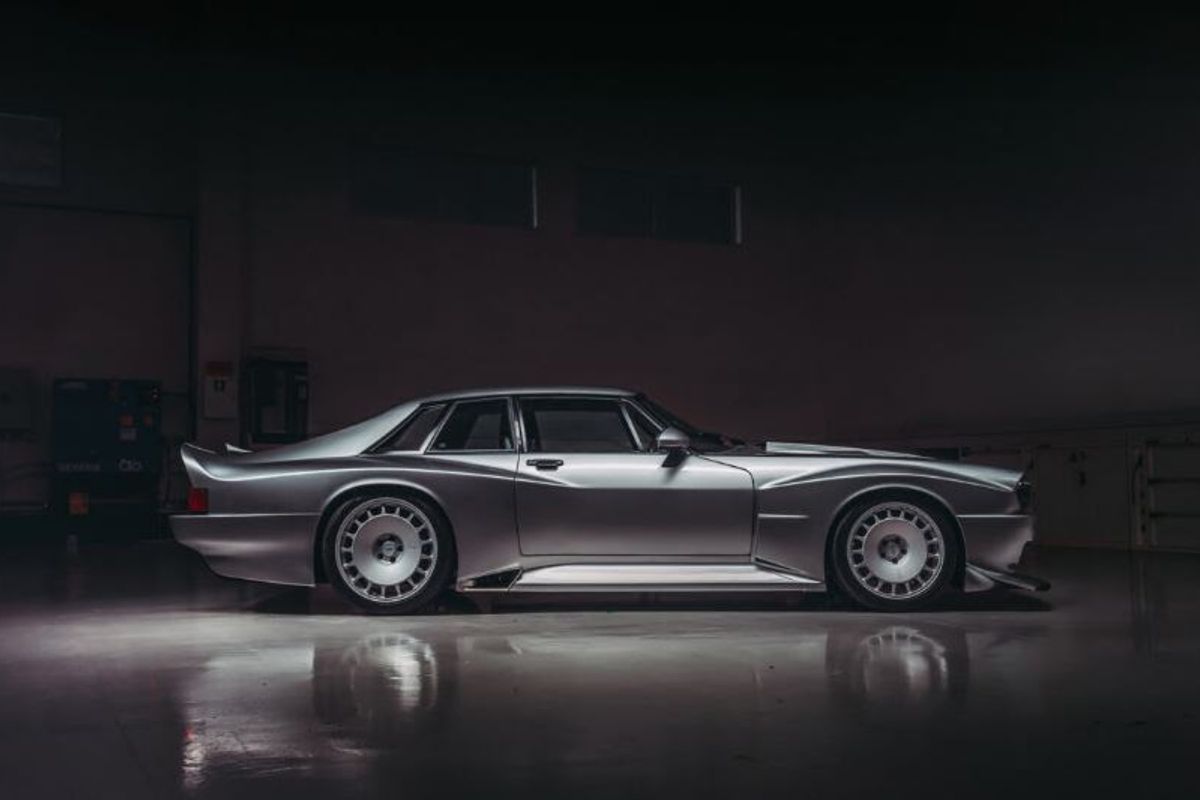
Once the old panels have been thrown in the skip, the Supercat receives a new tailored coat of armour in the shape of Saleem designed carbon fibre replacements, but with muscle; lots and lots of muscle. So much so in fact the track has been widened to 1604mm; 104mm wider than the original XJS.
Then there’s the mildly controversial carbon front splitter, and the ducktail rear spoiler, wonderfully inspired by the XJ220 Supercar. It’s not all show as John Kane explains. “It includes the result of full aerodynamic CFD and durability testing, that replicates highly dynamic driving scenarios on both the road and track”.
Saying that, the car has a target top speed of over 200mph, so it’s not like the aero is at all compromising top end performance. The test car has already seen 180mph.
During the 2 years of meticulous, research, design and development the team realised the C pillar vents on the original car actually created aerodynamic drag, so have now been cleverly and discreetly engineered to channel air over the rear wing - nice!!
Normally adding this much muscle increases weight - apparently, but in the SuperCat, c200kg has been shaved off to boast a kerb weight of just 1605kg, offering 412bhp per ton, mainly thanks to the carbon fibre body panels, and use of aluminium.
Suspension is TWR’s own bespoke set-up utilising unique subframes, double wishbone fronts, and multilink rear with fast road / track inspired, electronically adjustable TracTive dampers - far less harsh than full on race dampers, so perfect for a car you could drive happily to Monaco. Combined with a 104mm wider rear track over the original XJS, the SuperCat is lower, wider, faster and way cooler.
Contact with hallowed Goodwood tarmac is via 18” front and 19” rear HRE forged alloys wrapped in sticky Michelin Pilot Sport rubber; means the Supercat will be sure-footed speeding up the Goodwood Hill.
Stopping the Supercat sharply utilises large AP 6 pot front and 4 pot rear callipers with floating discs, and a Carbon Ceramic option.
Climb inside the Supercat and you’re immediately met with the scent and feel of high-quality luxury car materials. Plenty of hide options are available, but in the prototype shown at Goodwood this week, the interior is finished in an almost Havana cigar colour - how very Jaaaaaaag!!
The dash is ace, a full digitised version of the original XJS, complete with digital roller needles. The same fonts, digits and needles have all been replicated, albeit with a much higher speed and RPM count. Real thought has gone into this. We love it.
The turned aluminium gear selector, anodised knobs and controls with an uber-modern glow from the centre console, gives the Supercat a real modernistic feel. But look at your feet and you’ll see a proper race car Tilton pedal box, cossetted by luxury carpets. We just love this blend of race meets luxury, and makes for a successful Super-GT; a car you want to drive.
Seats are from Italian firm Sabelt, carbon bespoke replicating the shape and style of the XJS, but wrapped in luxury hides; super comfortable with support where needed, whilst navigating the Gotthard pass. But there are only 2 of them. So that means there’s enough room in the back or in the boot for a whole team’s golf equipment, or several extremely large shopping spree bags. Where else do you get that in a Super-GT?
An Alpine head unit with Apple Carplay / Android Auto takes care of the entertainment, and we love the nod to the TWR XJS racer, and XJ220, by using the same shaped 4-spoke steering wheel design, with a subtle reminder of who built the beast. TWR is embossed proudly onto the leather centre of the horn push area.
WHERE TO FIND THE SUPERCAT AT FOS
The SuperCat will viewable on the “New Classics” display. A new class for 2025 showcasing reimagined iconic cars from the past. Expect a 911 or two. The display will also sit neatly alongside the “First Glance” display showcasing new cars of the future. £50 and Mars bar says they won’t have a supercharged V12.
Click here for the EMM London website designed and built by Racecar