








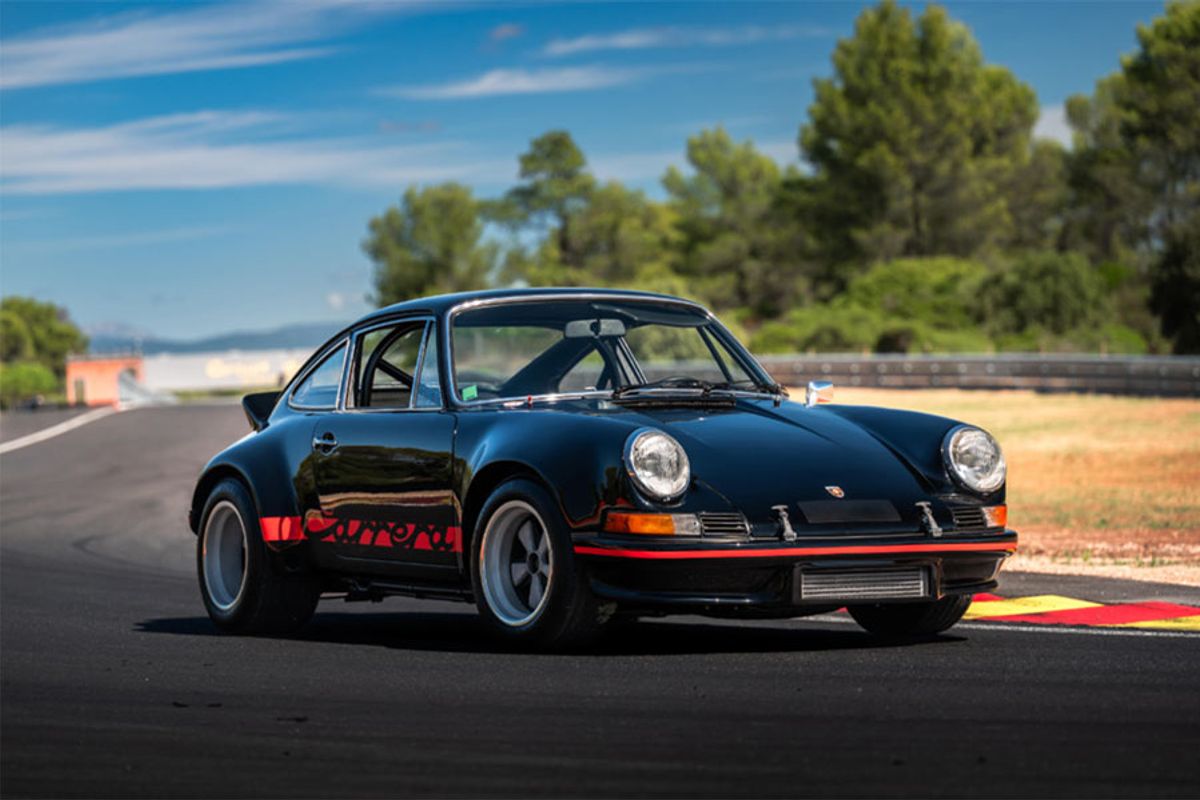
Mindful of the earlier tragic history - re-stamped motor - the fact that it didn't sell at Artcurial Monaco 4 years ago, the estimate of £870k - £1.3m doesn't seem crazy. As one of the two black m491's made from 49 in total - it's pretty cool. It is a bit trigger's broom - but at least the history of this car is well known and the buyer knows what they are getting - which is more than can be said for some of the other "virginal" 2.8 RSR's in the public domain!
Description by Bonhams below:
Ordered new by Peter Gregg from the Brumos Racing Team
Chassis no. 9113600940
Engine no. 6930133 (see text)
• 30th example of only 49 produced
• One of only two Black 911 2.8 RSR produced
• Raced by Formula 1 driver Peter Revson at the 100 Miles Lime Rock (6th OA)
• Recent participations at Le Mans Classic, Tour de Corse Historique and Tour Auto
• Registered in France
While 1,580 examples of the Carrera 2.7 RS were sold between 1973 and 1974, only 49 of these were built to racing specifications as 911 2.8 Carrera RSR. Although similar to the production 911, the shell was built with a thinner steel, paired with wider fender flares and plastic bumpers. The front one was notably intended to contain the oil cooler. The sound proofing was almost fully eliminated, as well as the rear seats, while the front bucket seats were made as light as reasonably possible. From the two batteries fitted on the standard cars, only one was kept on the RSR. The common glass used for the windows was replaced by thinner Glaverbel safety glass. The interior was only trimmed with black felt glued directly on the metal. The door panels were completely flat, only fitted with door straps acting on a simplified lock mechanism. The suspension remains quite similar to the 2.7 RS, with modifications on the rear suspension, including Delrin and Unibal joints, and auxiliary coil springs were mounted around the shock absorbers. The front suspension was only fitted with coil springs around the struts. The RSR also received quick adjustable and removable anti-roll bars. The braking system of the 2.7 RS was updated with ventilated and perforated discs fitted with aluminium callipers with adjustable balance from rear to front or reverse. The car hugged the road with 9- and 11-inch alloy wheels respectively on the front and on the rear. The engine itself has seen its bore increased to 92mm, raising the total capacity to 2806cc. The crankcase, crankshaft and connecting rods were the same as the standard 911S but racing camshafts were used, running on four bearings instead of three. The setting of the injection pump was modified to comply with the new engine specifications, and the ignition was upgraded to twin-spark specification. To limit the weight of the rotating components, the cooling fan was slightly smaller, and an oil cooler was fitted in the front bumper. In the end, the RSR version of the Flat-6 was producing 300 bhp at 8,000 rpm. The transmission was passing through a reinforced clutch, and the gearbox's oil admitted a separate cooler. The limited-slip differential had a locking factor of 80%.
As fitted, the RSR limited its weight to 900kg, a power to weight ratio which brought the car to a successful career in competition. In the mid-1970s the normally aspirated Carrera RSR dominated its class in World Championship sports car racing, winning at the Targa Florio, Daytona 24 Hours, Sebring 12 Hours and Nürburgring 1,000kms, defeating 3.0+litre prototypes from Ferrari, Matra and Mirage-Ford in the process, an outstanding achievement for a production-based motor car.
Porsche's policy had been to entrust defence of their GT division honours to private owners, and the Carrera 2.7 had been developed for this purpose. Although the factory also entered some examples, they usually ran in the Prototype class to avoid direct competition with the Zuffenhausen company's own customers. The RS was essentially the road-going version, the RSR the racer.
In total, only 49 examples of the 911 2.8 RSR were built between 1973 and 1974.
Chassis 0940 left the factory in March 1973 under production number 103564810, heading for the United States. It was painted black 1010 (two such models were delivered); fitted out with a code 11 black leatherette interior, as well as a 220 limited-slip differential, red lettering and a special transmission. This black 911 2.8 RSR, one of two produced, was then delivered new in Jacksonville in February 1973 to the Brumos dealership managed by Peter Gregg. It was sold to Arnold Golding in July 1973. On 15 September 1973, Golding entered it under number 5 for the Lime Rock 100 miles, accompanied by Formula 1 and Can-Am driver Peter Revson. The latter had already made a name for himself with the American public when he finished second, with Steve McQueen, in the Porsche 908 of Solar Productions Team - who produced the film Le Mans - at the 1966 12 Hours of Sebring. Arnold Golding not being a professional driver, at Lime Rock he only managed to take the Clarkson/Golding team's 2.8 RSR to 33rd place in the first race. On the other hand, Peter Revson's talent allowed him to move from 33rd to 6th place overall after 65 laps. Following this race, Revson reproached Peter Gregg and Michael Keyer's team for having received help from the Porsche factory, so much faster and sharper were their cars than the 0940 in his hands. Arnold Golding then, on 30th September 1973, entered his 911 RSR in an SCCA race at the Bridgehampton Race Circuit in Long Island when he came off the track after losing control of his vehicle. The RSR then hit a bridge pier and the driver was transported to hospital in Southampton, where he passed away a few hours after the incident.
The remains of the car were then purchased by Bill Schmid, then by Gary Kildall of Austin, Texas (an IT pioneer). In 1989, 0940 was acquired by John Starkey, an expert on the model and author of several reference books on the Porsche 911 R/RS/RSR. The black RSR was rebuilt during the 1990s before being presented for sale at auction in Monterey in 2001, where it was sold to James C. Moore of Detroit. James C. Moore and his RSR took part, notably, in several Historic Sportscar Racing events under the Klub Sport Racing team's banner. Incidentally, it was Phil Bagley, owner of the Klub Sport Racing team, who purchased the car in 2002. A restoration of the car to its original specifications was then undertaken. Phil Bagley, as an enthusiast of the Stuttgart firm, was naturally invited to take part in the Porsche Parade 2003 in West Palm Beach.
Having arrived in France in 2003, it was then the subject of an article in Flat 6 magazine. The RSR was acquired by Christian Perrier in 2004. He registered it in his name on 2nd February 2004 and immediately took part in the Tour de France Auto. He then entered it for Le Mans Classic. Sharing the wheel with M. Gonthier, they obtained 21st place in the weekend's third race. Still in 2004, Christian Perrier and the 0940 also took part in the Tour de España, and they returned in 2005. In 2006, Christian Perrier and Gérard Bouvet took part in the Tour Auto, finishing 9th overall. In 2008, the 911 and Christian Perrier took part in the Tour Auto once again before passing the car on to Jean-François Piquet in July 2009. At its wheel, he took part in 2010 in the Tour Auto and the Tour de Corse Historique, then in the Ronde du Ventoux 2011. It was then maintained at the Modern Garage in Domène and we have numerous invoices from this period. The 911 RSR changed hands in 2014, acquired by its current owner via Claudio Roddaro. In 2017, the car obtained its FIVA identity card.
Today, 0940 is in recently restored condition. The number 9113600940 is stamped under the front bonnet, corresponding to its registration plate, stamped with the same number. The figures 1035648 are stamped under the dashboard and correspond to its production number of the time. The engine casings bear the casting numbers 901.101.102.7R and the cylinder heads 901.105.11.1R. The dual ignition injection engine, restored by Manfred Rugen in 2010 is stamped with type 911/72 and number 6939133. The last number was the car's engine number when it left the factory, but has been re-stamped. Its black-painted coachwork coupled with red lettering blends aluminium trim, fine sheet metal and polyester. Its passenger compartment is equipped with a four-point roll-cage, Recaro seats consistent with the originals, as well as safety harnesses and an extinguisher system.
Sold with its historical file including various press articles, photographs, invoices and expert reports, it has its French registration document and its FIVA passport. One of only 49 models, this is a rare opportunity to acquire the famous 2.7 RS's big sister. Although it has suffered the tribulations of racing in its time, as have many other 2.8 RSRs, this 911 is rare in having begun its sporting career in the hands of a Formula 1 driver! Eligible for numerous events around the world, as its previous owners have proven, it will need to be fully serviced before taking to the track again, having been little used since its last restoration.
Click here for details on this Porsche 911 2.8 RSR