









Magical 2025 RM Sotheby’s Veteran Car Run pays special tribute to the 1000 Mile Trial as huge crowds cheer on plucky participants
As dawn broke over autumnal London, 384 pioneering veteran cars, their intrepid drivers and passengers, and crowds of early-rising well-wishers gathered in Hyde Park this morning (Sunday, 2 November). Despite pre-dawn rain, spirits remained high as everyone eagerly awaited sunrise to signal the start of the 2025 RM Sotheby’s London to Brighton Veteran Car Run – the latest staging of the world’s longest-running motoring event.
This magical annual institution is the largest and most remarkable gathering of veteran vehicles on Earth. It’s also a true celebration of the life-changing benefits that accompanied the birth of motorised transport at the end of the 19th century.
It is now 129 years since the original Emancipation Run of 1896, which celebrated the passing of the Locomotives on Highways Act. That landmark legislation raised the speed limit for “light locomotives” from 4 to 14 mph and abolished the requirement for a man to walk ahead waving a red flag.
Evoking that freedom, today’s much-loved homage began, as always, with the symbolic tearing-up of the red flag – a pre-dawn ritual that this year also marked the 125th anniversary of the game-changing 1000 Mile Trial of 1900. That audacious 22-day journey introduced the new-fangled motor car to communities across the nation.
To honour this milestone, the red flag was torn up by racing driver and broadcaster Alex Brundle and presenter Charlotte Vowden, who had the privilege of leading the field away from Hyde Park driving a very special 1899 Wolseley 3.5hp Voiturette.
Affectionately known as OWL (after its registration plate), this Wolseley belongs to the British Motor Museum collection in Gaydon. It is the only working survivor from the original 1000 Mile Trial.
As daylight arrived on an unseasonably warm – if wet – morning, the Run’s curtain-raiser featured a group of pre-1905 motor and pedal cycles, also bound for Brighton. Notably the brave penny-farthing riders drew admiration as they set out for the Sussex seaside resort’s Madeira Drive.
Precisely at 7:00am, with the sun rising, the first batch of pre-1905 ‘horseless carriages’ was flagged away by Duncan Wiltshire, Chairman of the Royal Automobile Club, which has lovingly curated the Run since 1930.
The oldest Victorian ‘light locomotives’ led the cavalcade as an extraordinary variety of ancient cars chuffed and wheezed their way through Wellington Arch and down Constitution Hill, past Buckingham Palace, through Admiralty Arch, and into Whitehall. Then it was edging Parliament Square and across Westminster Bridge beneath the gaze of Big Ben. Here, the 60-mile route divided in two to ease traffic flow in south London.
Half of the participants followed the traditional A23 route via Kennington, Brixton and Streatham Common, while the other half travelled across Lambeth Bridge, through Vauxhall, Clapham Common and Tooting. With the weather improving, the two routes merged again on the A236 north of Croydon, reuniting the cavalcade as it headed towards the South Downs in Surrey and West Sussex.
As ever, vehicles set off in age order, with the earliest starting first in OWL’s wheel tracks, allowing the first pioneers the most time to reach Brighton.
Among the early starters was the much-loved Salvesen Steam Car – effectively a steam locomotive for the road, complete with a stoker shovelling coal into its fiery furnace. It was joined by numerous motorised tricycles, many with riders and passengers dressed in charming period attire.
Mercedes-Benz Heritage previewed a key anniversary. In 2026, it will be 100 years since Daimler-Motoren-Gesellschaft and Benz & Cie merged to form Daimler-Benz AG, creating the Mercedes-Benz brand. Anticipating this centenary, the company entered a 1901 Benz Spider and a 1904 Mercedes-Simplex. Although the Simplex was unable to start, the Spider successfully completed the course.
Thereafter followed a staggering variety of antique machinery dating back to motoring’s earliest days – some with steering wheels, others with naval-inspired tillers; some powered by petrol, others by steam, and even a few by early electric batteries.
This diversity reflected the pioneering spirit of innovation as different propulsion systems competed to define the future of transport – a dilemma echoed in today’s automotive industry. Reflecting the modern shift toward sustainability, several veteran cars ran on SUSTAIN’s e-fuels, while the Salvesen operated on eCoal, made from a blend of olives, coffee and molasses.
While the Run looked ahead to a greener future, it also honoured a bygone age when motoring technology was in its infancy – long before roofs, windscreens, heaters, radios or satnavs became standard.
As always, the event’s eccentric charm and deep heritage drew huge crowds along the route. Tens of thousands of spectators lined the pavements and verges to cheer on participants throughout the journey.
The Run attracted entrants from across the globe, including cars from Australia, Austria, Belgium, Canada, the Czech Republic, France, Germany, Holland, Hong Kong, Ireland, Italy, Monaco, Sweden and Switzerland, along with a 26-car contingent from the United States.
In total, more than 100 marques were represented – from Adler, Albion and Argyll to Waverley, Winton and Wolseley. A handful of names, such as Cadillac, Ford, Renault, Vauxhall and Mercedes-Benz still thrive today, though most are long defunct. Among these, De Dion Bouton had the largest showing, with over 50 entries.
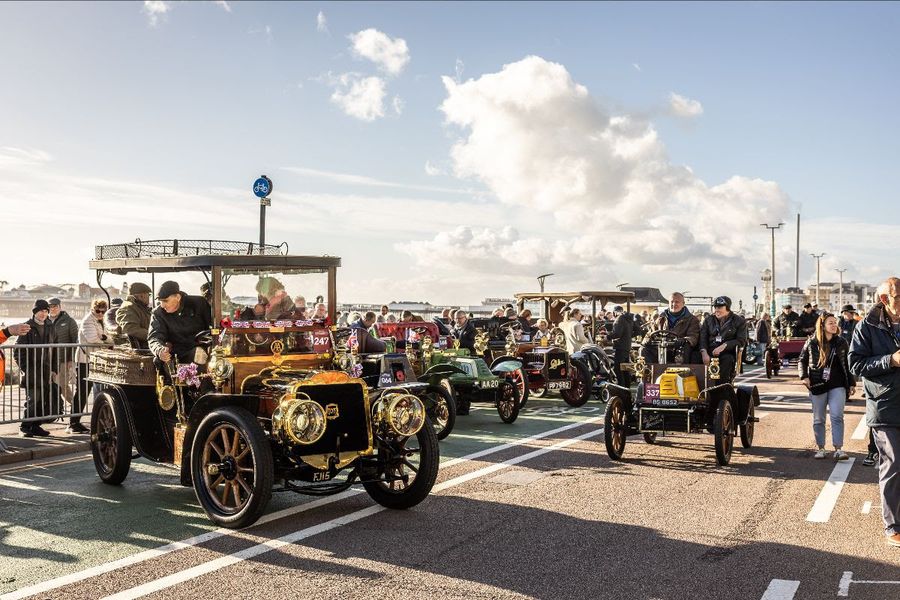
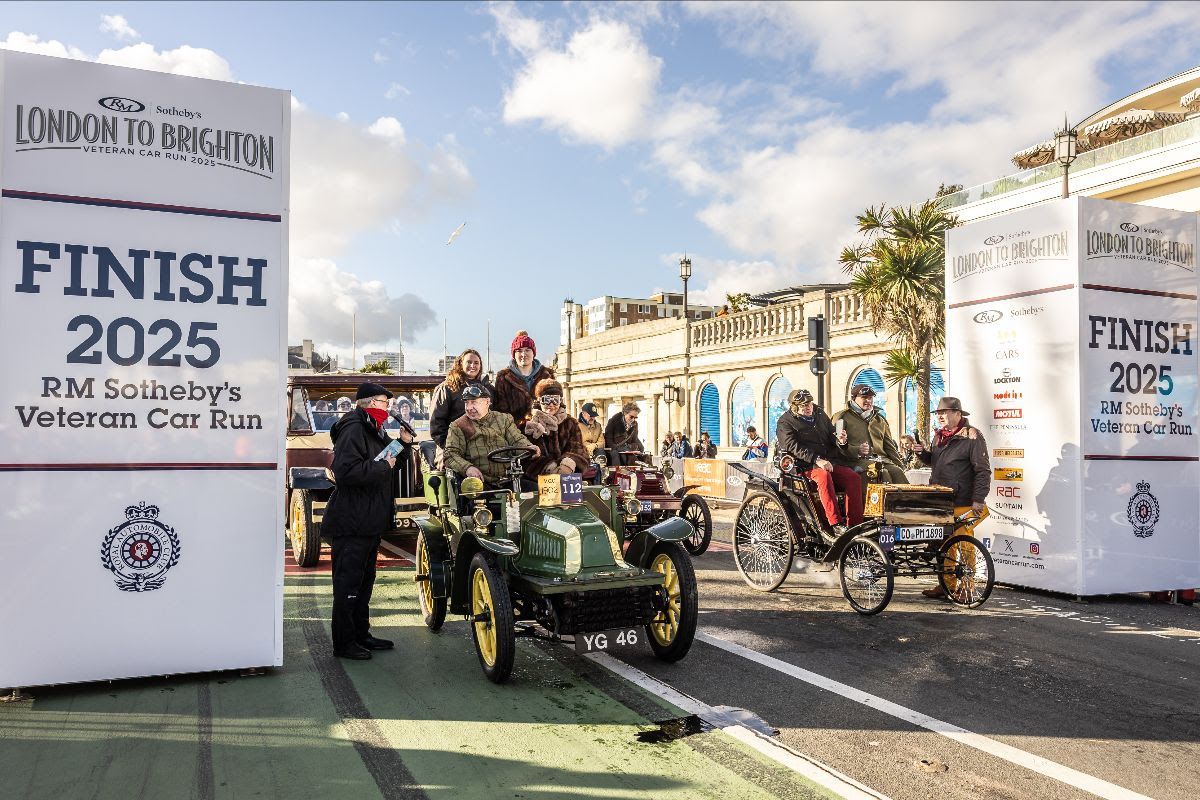
Taking advantage of bright Sussex sunshine, no fewer than 340 starters completed the celebrated journey to Brighton before the 4:30pm deadline, proudly collecting their coveted finisher’s medals. Many hailed the 2025 Run as one of the best ever, praising the ever-improving route signposting, the 280 enthusiastic volunteer marshals, and the fervent support from well-wishers along the way.
The first car to reach the Sussex seafront was the No 46 Renaux tricycle, winner of the 1900 Paris-St Malo road race, completing the journey in just under four hours to be greeted by the Mayor.
Having flagged away the early starters, Duncan Wiltshire enjoyed an untroubled run to Brighton aboard a 1901 Mors owned by the Royal Automobile Club.
“What a fantastic RM Sotheby’s London to Brighton Veteran Car Run it has been today,” said a delighted Wiltshire. “The turnout from spectators was mighty impressive, with some of the biggest crowds I’ve ever seen lining the route once the sun came out. You also have to marvel at the organisation. This is an incredibly complex event, seamlessly overseen by hundreds of wonderful volunteer marshals who ensure the smooth and safe progress of these extraordinary vehicles.
“This has been a fabulous way to celebrate the 125th anniversary of the 1000 Mile Trial. Our 60-mile journey from London to Brighton on modern roads felt pretty heroic, so it’s hard to overestimate the enormous challenge faced by those spirited early motorists on their nationwide adventure back in 1900 – a feat well worth saluting in this milestone year.”
Having led the field away from Hyde Park, Alex Brundle was equally thrilled to reach Brighton after completing his first Veteran Car Run.
“It was such a joy and an incredible experience – my sincere thanks to the British Motor Museum,” he said. “Shamefully, I didn’t know much about the event before, but now I’ve completely fallen in love with it! To have the honour of tearing up the red flag and leaving Hyde Park first, driving OWL in such a milestone year for the car, was amazing. Being in one of the older cars was a real challenge, which only added to the fun… as did seeing so many people lining the roads. I was blown away by the crowds.”
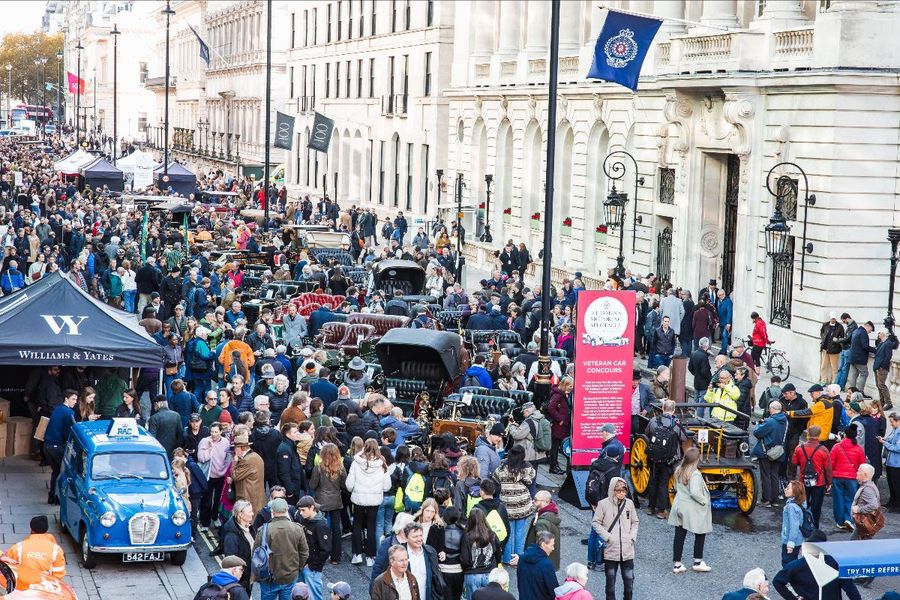
The RM Sotheby’s Veteran Car Run provided a fitting climax to the Royal Automobile Club’s busy London Motor Week, which featured a host of events. The penultimate highlight was the free-to-view St James’s Motoring Spectacle on Pall Mall – the perfect curtain-raiser to today’s grand finale.