








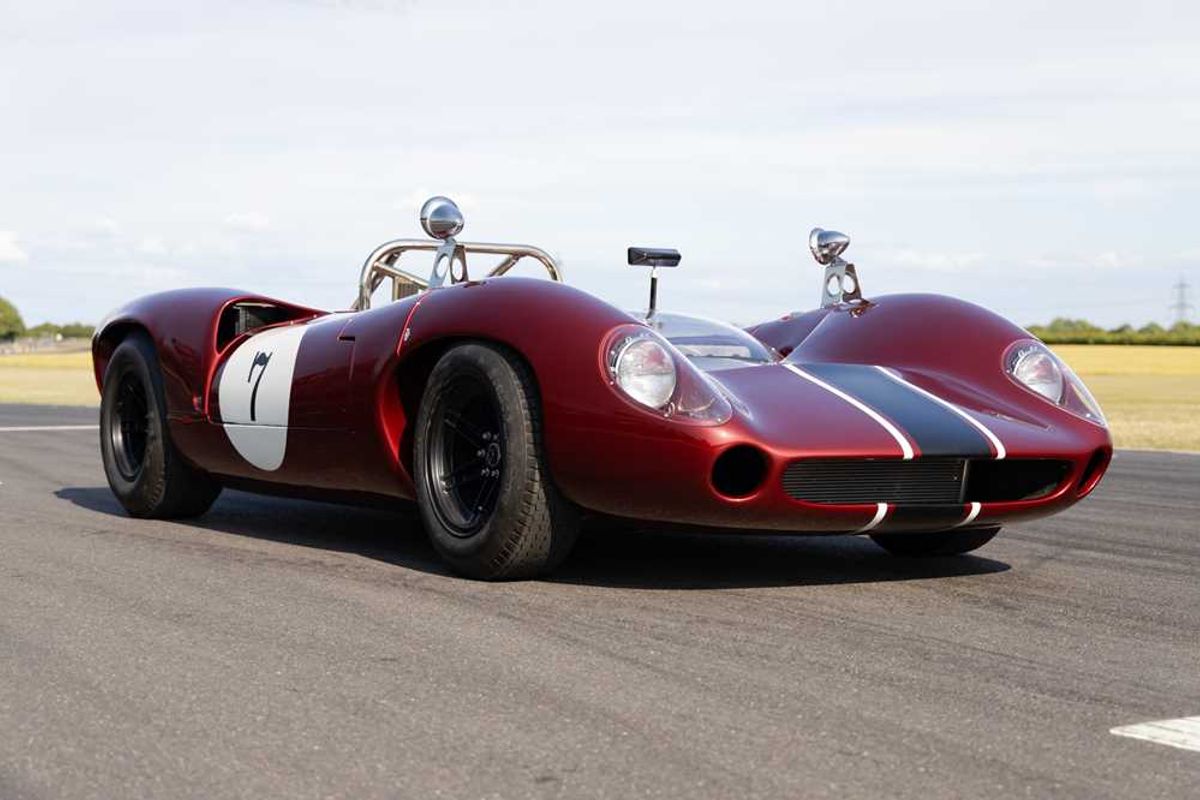
Built to 1965 specification with a current FIA HTP
Estimate £170,000 - £210,000
Registration No: N/A
Chassis No: SL142/22
MOT: N/A
Eligible for some of the world's most iconic historic motor racing events
Offered for sale with a valid FIA HTP up to January 1st 2036
Subject to a comprehensive restoration completed in 2025
Fitted with a Chevrolet 'small block' engine with an understood 440 BHP
Said to be a highly competitive race car
Lola's sublimely beautiful T70 Spyder sports-racer is historically significant as winner of the first ever Can-Am Championship. It was designed and manufactured by Lola Cars Ltd, of Bromley, Kent, a relatively young company that had been building competition cars for only seven years prior to the T70's introduction in 1965. From humble beginnings, Lola Cars quickly established a winning reputation and grew to become a major force in world motorsport. Eric Broadley, his cousin Graham and Rob Rushbrook, at whose garage premises the first customer production versions were made, were the architects of the early success, which continued with a front-engined, single-seater Formula Junior, the Mk2.
Among Broadley's early projects was the Mk6 GT coupé, which had been designed to take advantage of readily available American V8 engines that offered the ideal combination of compact size and adequate performance. Lola's first monocoque design, the Mk6 GT became part of Ford's Le Mans programme in 1963, Broadley having been hired by the American company to assist with the development of what would emerge as the all-conquering GT40. At odds with his American bosses, Broadley left in 1964 and the following year, having penned a handful of Formula 2 monopostos, returned to sports cars with a new design for Group 7 racing: the T70. Effectively a 'formula libre' for sports prototypes - enclosed wheels and provision for an onboard spare were just about the only regulations - Group 7 was becoming popular on both sides of the Atlantic and the potential market for such cars looked promising.
Designed to accept American V8 engines, the T70 Spyder incorporated a full-length monocoque body tub fabricated of aluminium panels on a steel framework, the engine being bolted to the firewall bulkhead as a semi-stressed member. The suspension was conventional, boasting unequal length wishbones and coil spring/damper units all round, though the positioning of the disc brakes inboard of the wheels was an unusual feature, adopted in the interests of better cooling.
John Surtees was one of the first customers for the T70, running what in effect was a 'semi-works' team in 1965. Traco-prepared Chevrolet V8s were used, a 5.0-litre unit at first and then from mid-season a 5.9. A Mk2 version of the T70 became available before the end of the '65 season, Broadley taking advantage of the forthcoming deletion of the 'spare wheel' requirement to redesign the nose, replacing the original twin radiators with a large single unit while incorporating a host of detail improvements to both chassis and suspension. The result was a significantly quicker car, which in prototype form was driven to a convincing victory by Surtees in the Guards International Trophy at Brands Hatch on the August bank holiday weekend. Surtees then wrote off the prototype Mk2 at Mosport Park in Canada following a suspension failure, sustaining injuries that put him out for the rest of the season.
He bounced back in 1966, winning three of the inaugural Can-Am Championship's six races for Lola and defeating rivals McLaren and Chaparral in the process. Privately entered T70s won two of the other races making it a magnificent five out of six for Lola. Surtees' success capped what had been a tremendous year for the British manufacturer in North America, Graham Hill already having won the celebrated Indianapolis 500 in a T90.
Although the works McLarens would dominate Can-Am for the next five years, the Lola T70 remained a popular choice for privateers, among whom it was rated as the sweetest handling of the customer cars. Given its Can-Am origins, it is not surprising that the long-serving T70 family of sports cars was better suited to sprint events, yet against the odds a Mk3B coupé entered by Roger Penske lasted the distance to win the coveted Daytona 24 Hours endurance classic in 1969.
Chassis number S142/22 was originally fitted to a Lola T142 F5000 car, which had achieved success in circuit racing and hill-climb competitions in the eary 1970s before dropping off the radar once acquired by Derek Robinson of Motor Racing Supplies of Somerset in 1975. A number of years later, a Lola T70 Mk2 Spyder emerged wearing the same chassis number as the T142 mentioned earlier. Some reports suggest that the car may have been broken up with components being moved over from the T142 to a T70 – a common practice for F5000 chassis which were less desirable and comeptitive than the T70 at the time. When the now sadly deceased vendor came into ownership of this car in 1997, chassis S142/22 came equipped with a Lola T70 Mk2 Spyder tub, engine, gearbox, pedal box and suspension components, but had been damaged in a hill climb accident and needed totally restoring. This task was carried out by the vendor for a number of years before he sadly passed away. Wiltshire based engineering firm and sports prototype manufacturer Loaded Gunn Racing was chosen to complete the restoration, and has since carried out a total recommissioning of the T70.
The comprehensive restoration spanned over 10 years and included a refurbished Hewland LG500 4-speed gearbox with Salisbury type plated limited-slip differential and a fresh 350 Chevrolet Race engine with angled spark plug heads, wet sump and total loss charge system which was built by Nick Adams Race Engines. The new race engine now produces 440bhp at 6800rpm putting the car at around 550bhp per tonne on its current sidedraft carburettors, a competitive figure for the categories it is eligible for. The car is offered for sale fully restored, with new FIA Historic Racing Papers to 1965 specification. All original period components have been crack tested, including uprights and wheels complete with new plumbing and pipework throughout. Features include: custom motorsport wiring loom, Koni steel body dampers and springs, brand new Dunlop CR65 Race Tyres, nickel plated suspension components, bespoke stainless manifold and exhaust system with silencer add-ons included, refreshed bodywork (50% original / 50% genuine replacement panels).
An FIA specification fire extinguisher system is fitted as well as an FIA bag tank along with new engine ancillaries. Having recently been inspected and approved as a 1965 car with a valid FIA Historic Technical Passport until 31st of December 2035, this Lola is eligible for some of the most prestigious historic racing grids throughout the world. The sale includes a history file of receipts from the build including engine dyno printouts, receipts for items such as the engine and gearbox, build receipts from the engineering shop as well as the new and current FIA Historic papers.
Auction: December 3rd