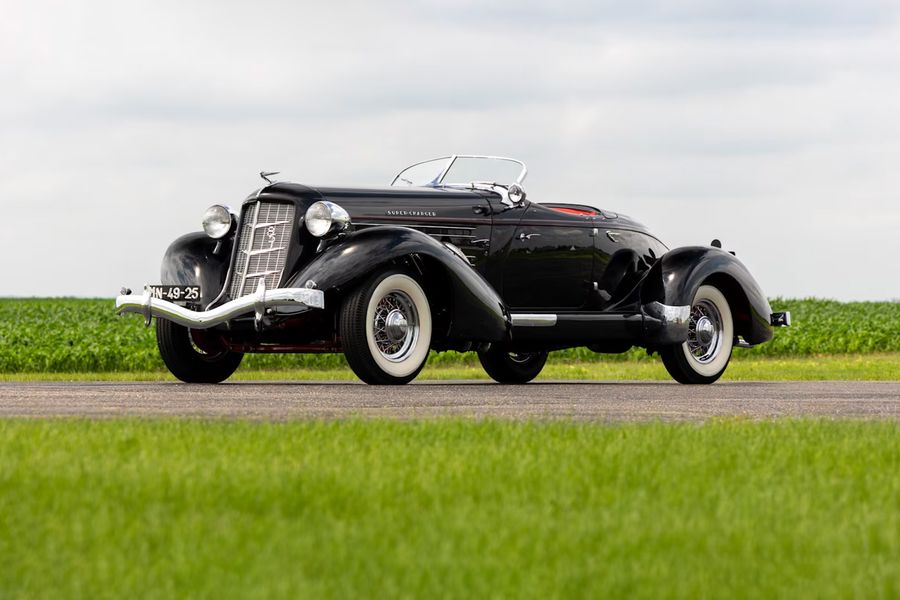






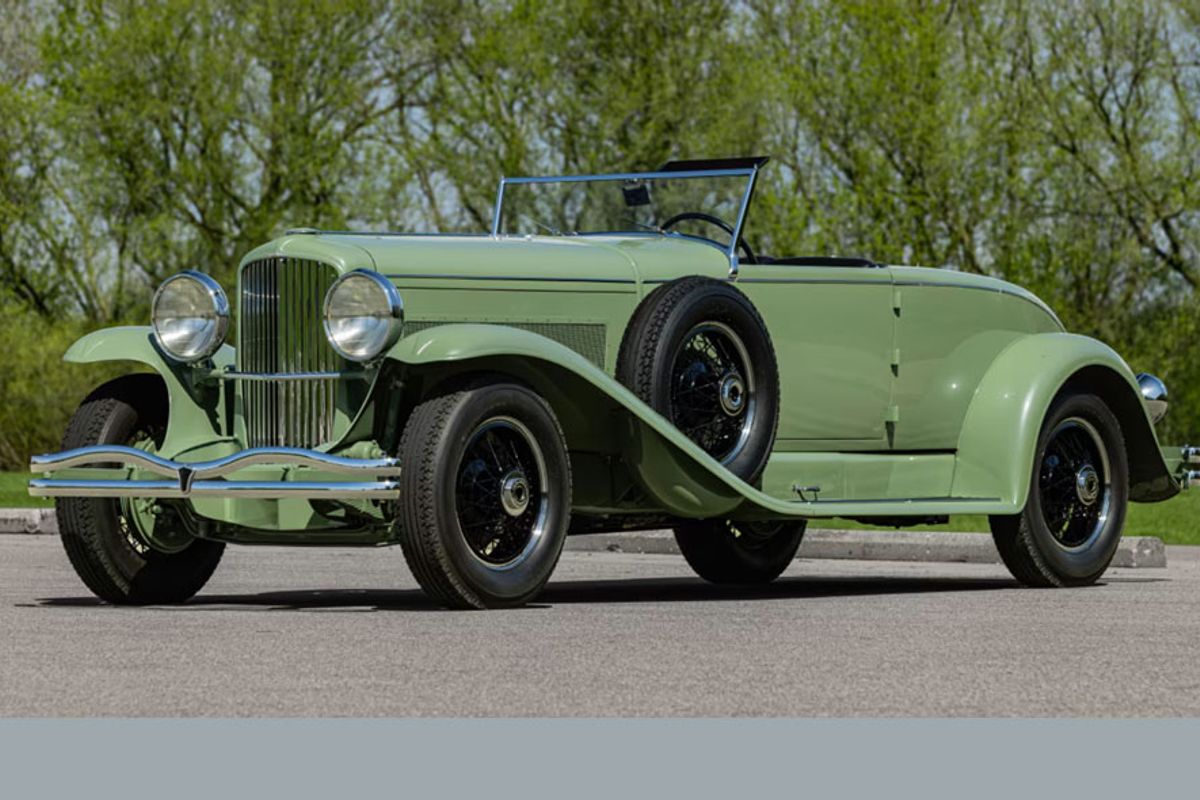
1933 Duesenberg Model J Disappearing-Top Convertible Coupe - When it comes to the history of the American automobile, there has probably been more written about the Model J Duesenberg than any other vehicle ever produced
ENGINE 420/265 HP Inline 8-Cylinder
TRANSMISSION 3-Speed Manual
EXTERIOR COLOR Green
INTERIOR COLOR Black
HIGHLIGHTS
Ultra-desirable Walter M. Murphy Co. disappearing-top coachwork
Previously owned by famed racer, team owner and USAC founding father Bob Estes for approximately 40 years
Believed to be among the last Model Js bodied by Murphy before the coachbuilder closed its doors in 1932
Original chassis, engine and bodywork
Restored by the renowned Stone Barn Automobile Restoration of Vienna, New Jersey
Displayed at Pebble Beach five times between 1970 and 1985
Pictured in Dennis Adler's book "Duesenberg"
Chassis no. 2446
Engine no. J-429
Body no. 913
420/265 HP DOHC inline 8-cylinder engine
Single dual-throat updraft carburetor
3-speed manual transmission
Live-axle suspension
Semi-elliptical leaf springs
Double-acting hydraulic-level shock absorbers
External SJ-type exhaust pipes
4-wheel hydraulic drum brakes
Wire-spoke wheels
THE STORY
When it comes to the history of the American automobile, there has probably been more written about the Model J Duesenberg than any other vehicle ever produced. No matter what has been said about this vehicle in the past or present, almost all who have had first-hand experience with the mighty Model J agree on one thing: it was the most remarkably superior machine ever produced in America.
When it was new, it surpassed the finest American and European automobiles produced during its day. There were no other vehicles that could equal the Model J’s combination of technical sophistication, power output, performance, smoothness and superlative road manners. When it came to power, the Model J easily surpassed its competitors with its 265 HP unsupercharged engine.
The Model J was formally introduced on December 1,1928 at the opening day of the New York Auto Salon, where it caught the public completely by surprise. The chassis carried a base price of $8,500.00, and coachwork for the chassis ranged from $3,500.00 to almost $10,000.00 more. The first Duesenberg Model J was sold in 1929, and the bulk of the Model Js and SJs produced were manufactured and sold between 1929 and 1933.
Duesenberg’s client list included some of the most famous names in American history, such as William Randolph Hearst, Howard Hughes, George Whitell, Tommy Manville and Paul Whiteman. Hollywood superstars were also amongst the privileged few that could own a Duesenberg, and Model Js were purchased by such well-known stars as Marion Davies, Tom Mix, Gary Cooper and Clark Gable.
The Walter M. Murphy Company constructed bodies for many expensive automobiles, including Rolls-Royce, Mercedes-Benz and Packard, however, it’s most famous for its work on the Model J Duesenberg. Perhaps its most popular and most recognized body style was the convertible coupe, which accounted for approximately one third of Murphy-bodied Duesenbergs. By the early 1930s, Murphy had begun constructing these bodies “in the white” so that customers seeking the convertible coupe would not have to wait to receive coachwork for their new Duesenbergs.
In the early 1920s, General Manager George R. Fredricks and Designer Charles Gerry developed an articulation that retracted a convertible top completely into a well behind the seats. This allowed it to be discreetly covered by a metal canopy when not in use. It also gave the bodywork a seamless, speedster-style profile and a modern appearance. Bodies that employed this system were known as Disappearing-Top Convertible Coupes. This eventually evolved into a true “disappearing top” model, in which a flush-fitting metal lid replaced the tonneau, creating a smooth, flat line that ran from the edges of the hood to the doors and down over the rear deck. This top, coupled with Murphy’s signature thin “Clear-Vision” windshield pillars and disappearing side windows, gave the convertible coupe the sporting appearance of a true roadster.
Unlike the standard convertible coupes, which were often produced for Duesenberg factory stock, the Disappearing-Top models were all fully custom, as recognized by their 900-series body numbers, and they were built for their original owners. This special status, along with their spectacular lines, has made them perhaps the most iconic bodies on the Model J chassis.
The chassis for this 1933 Duesenberg Disappearing-Top Convertible Coupe, J-429, was completed on December 30 of 1930 and testing began at the Duesenberg factory in Indiana. It was sold to its first owner as a bare chassis and then delivered to the Walter M. Murphy Company, where it received the Disappearing-Top Convertible Coupe body style bearing body no. 913. It is believed this was among the last Model Js bodied by Murphy before the coachbuilder closed its doors in 1932.
By the late1940s, J-429 had passed into the care of a Hartford, Connecticut, attorney. At this point in history, the car was outfitted with external SJ-type exhaust pipes.
The car was sold in May 1948 through car dealer Russell G. Sceli to David S. Bloom, a student at the Massachusetts Institute of Technology. Bloom did not own the car for very long, selling it in June 1949 to Charles Allen, a resident of both Pennsylvania and California. Allen installed sweep-hand instruments. After discovering an issue with the clutch or transmission, Allen decided to store the car in Pennsylvania. It remained in storage until July 1961.
In 1961, the Duesenberg was bought by Bob Estes in Los Angeles, who paid $5,500. Estes was not simply a race person, as he liked fast cars too. He purchased the original 1933 Duesenberg, J-429, Murphy convertible coupe with its disappearing top. Robert Stewart “Bob” Estes was a prominent American race car owner, automotive dealer and motorsports figure whose career spanned decades of American open-wheel and sprint car racing. Born in Los Angeles to Clifford and Lenore Estes, he developed a lifelong passion for cars and racing from a young age, influenced by his father’s engineering work and early exposure to racing shops. In high school, he modified a 1925 Model T Ford to a record 111 MPH at Muroc Dry Lake in 1930. He later raced sprint cars in Southern California before shifting focus to automotive engineering.
After World War II, Estes opened a Lincoln-Mercury dealership in Inglewood, California, where his “Bob Estes Special” became a name in motorsports. He sponsored and entered cars in multiple series, including midgets, sprint cars, stock cars and Indy 500 entries. His team competed in the AAA Mid West Sprint Car Championship, winning titles in 1953-54 with Pat O’Connor.
Estes fielded several Indianapolis 500 entries, most notably the Bob Estes Special, a 1954 roadster built by A.J. Watson and driven by Don Freeland to seventh place in 1954. This was the first Watson-built roadster to complete 500 miles at Indy. He also entered cars in the 1950s with drivers like Joe James and Jim Rigsby, though some entries failed to qualify.
Estes combined the roles of businessman, engineer and race team owner, leaving a mark on both sprint car and open-wheel racing in the 1950s. His cars, especially the Bob Estes Special, are remembered as part of the “Roadster Revolution” that transformed Indianapolis racing.
When Estes passed away in 2001, J-429 changed hands through some prestigious car collectors. The car was first purchased by John Groendyke of Enid, Oklahoma. It was soon sold to Dave Kane of Bernardsville, New Jersey. In 2003, J-429 was purchased by Ray Scherr, who gave J-429 its first comprehensive restoration. The next owner, Craig McCaw, appreciated the originality of J-429 and maintained the car until it was sold to the current owner.
With the current owner, J-429 has been updated substantially by Tim Purrier, the owner of Straight Eight in Troy, Michigan. The car has been maintained on a regular basis and has been driven as well. Since the work has been completed, the car has not been shown or judged at any major concours events. J-429 is likely among the best of the Duesenbergs with its original Disappearing-Top Convertible Coupe. The history is well-known and its impeccable originality has been appreciated by many of the best collectors.
Text & Image: Mecum