









YOUNG AMERICAN’S RACING PATH SPEEDING TOWARD FORMULA ONE, USGP
An American driver could race in the United States Grand Prix at the Indianapolis Motor Speedway and the rest of the FIA Formula One World Championship as early as 2006, if everything goes to plan in the Red Bull Driver Search program.
Scott Speed, a 21-year-old from Manteca, Calif., and Colin Fleming, a 20-year-old from San Diego, both had outstanding seasons racing in Europe in 2004. Both will take another step toward Formula One as they move up the ranks of the European racing ladder in 2005.
In 2004, Speed became the first American driver to win a junior formula championship in Europe as he clinched both the German and Eurocup Formula Renault titles. Fleming finished second in the German championship and third in the Eurocup series.
Plans have yet to be finalized for 2005, but Fleming is likely to compete in the Renault V6 World Series, which has been formed by a merger of the Nissan World Series and the Renault V6 Eurocup, while Speed will probably race in the new GP2 series that replaces the FIA Formula 3000 International Championship and will run in conjunction with F1 Grand Prix weekends in Europe.
“My plans have yet to be decided,” Speed said, “But GP2 is looking like the biggest possibility. And, along with that, I am sure that Colin and I will both be testing the (Red Bull F1) car and getting ready for ‘06. But I don’t know anything for sure yet.”
Red Bull, the Austrian energy drink company owned by motorsports fan Dietrich Mateschitz, recently bought the Jaguar Racing F1 team from Ford. Mateschitz has long stated that he wants to see a U.S. driver competing in F1.
To achieve that goal, Red Bull started its Driver Search program to seek out, finance, train and groom young U.S. drivers on the road to F1. 1985 Indianapolis 500 winner and former F1 driver Danny Sullivan and former F1 driver Helmut Marko oversee the program.
And now that Red Bull owns an F1 team, it will have direct control over the drivers it chooses for both race and test roles.
Right now, Speed and Fleming are the most promising candidates to become the next F1 driver from the United States.
Asked how close he thinks he is to getting into F1, Speed replied, “2006.”
Speed’s racing career started at age 10 when he began to race karts. His father, Mike, who also races karts, is an F1 fan. And that is how Scott Speed’s goal to become a top F1 driver began.
“I was influenced by my father,” Speed said. “He was interested in F1 and watched it, and so that it what I wanted to do. It is my personality to be very competitive, and I want to be the best at something. I was playing all kinds of sports as a kid, and racing was the only thing I was really good at, and so I stuck with that. I made my goal the top of that level, which is F1.”
Speed’s advancement through the racing ranks has come because of his talent and hard work rather than family money. He has made his mark on merit alone.
Success in several racing driver schools led to him being awarded scholarships in the Skip Barber and Jim Russell racing school programs in the United States.
The next goal was to race in Europe. The competition in Europe is intense, with legions of drivers fighting for a chance to join the elite ranks as one of the 20 F1 drivers. Speed knew from the start that the best way to reach F1 would be to compete in the tough European road-racing environment.
“I knew that we had to go to Europe,” Speed said. “How I was going to do that was really unknown at the time. My family didn’t have enough money to support me to go over there, and finding sponsorship was definitely not something I was good at.”
Speed’s chance to race in Europe came when his talent earned him a spot in the Red Bull program, and in 2003 he competed in the British Formula 3 series. Unfortunately, a long illness, eventually diagnosed as colitis, severely hampered his season. He lost 22 pounds before he began to recover. He bounced back strongly in 2004 in Formula Renault.
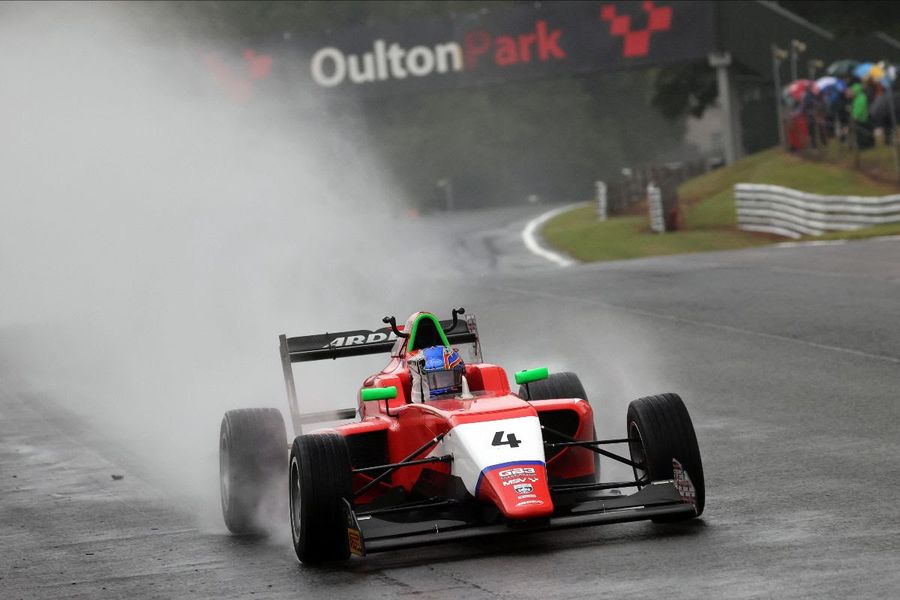
Formula Renault cars are single-seater open-wheel race cars that develop about 200 horsepower and are capable of speeds of 160 mph. A number of countries in Europe, including France, Germany and Italy, play host to individual Formula Renault championships. Of these, the German series arguably is the most competitive. Fleming and Speed were teammates on the Motopark Academy team based in Germany.
Speed won four times and finished on the podium 11 times in the 14-race German series, where he edged Fleming to win the championship.
The Eurocup consists of 17 races in six European countries. Speed dominated that series. He started from the pole nine times, won eight times and finished on the podium 11 times on his way to a championship. Fleming ended up third in the final standings.
In October, Speed and Fleming had the opportunity to demonstrate their talent in front of the Formula One teams as they finished first and second, respectively, in a Formula Renault race held in conjunction with the inaugural Chinese Grand Prix in Shanghai.
Fleming and Speed share an apartment near Salzburg in Austria. It wasn’t easy for the two to be so far away from family and friends.
“That was definitely difficult,” Speed said, “and living with Colin is the only thing that made it bearable.”
Speed and Fleming helped dispel the myth that young drivers from the United States can’t compete against the best up-and-coming drivers racing in Europe.
“That feels good,” Speed said. “We always knew we could; it is just like anything else of being in the right situation.”
The “right situation” is giving American drivers the right conditions and tools to compete in Europe.
“You can see right away that we were able to be competitive,” Speed said.
Red Bull’s program involves much more than just financing young drivers.
“The biggest difference between the Red Bull program and other programs out there that are similar to this is that Red Bull are not just putting us over there and paying for our season,” Speed said. “They are also training us in every aspect of being a race car driver. We have a fitness-training center over there in Austria that is great for us.”
Sullivan and Marko keep an eye on the Red Bull protégées.
“Danny has raced in Europe, and he was really helpful to us in the beginning,” Speed said. “Helmut, I don’t know how much advice he gives us, but he definitely tells us when are messing up!”
Speed is dividing his time between Europe and the United States during this offseason as he is taking part in a fitness clinic in Phoenix to prepare for the 2005 season.
He also had the chance to test an IndyCar® Series car when he drove one of Red Bull Cheever Racing’s cars Dec. 17 at Sebring International Raceway in Florida.
“It was my first time driving an IndyCar, so I didn’t know what to expect,” Speed said, “but the car handled really well and was a very powerful package to drive compared to the Formula Renault cars. I worked really well with the whole Red Bull Cheever Racing team and had an awesome experience.”
Team owner Eddie Cheever Jr., the 1998 Indianapolis 500 winner and a former F1 driver, was impressed with Speed’s performance.
“Scott Speed’s driving skills were very impressive, especially for a racer at such a young age,” Cheever said. “His performance and feedback were excellent. It was a great opportunity to have him test his skills in another application and compare those skills to existing IndyCar drivers.”
Speed says it would be a very special feeling to line up on the grid of the Indianapolis Motor Speedway for the United States Grand Prix and compete in his home F1 race. And he is aiming to be near the front of the grid in every Grand Prix.
“I am not going to F1 to line up on the back of the grid,” he said.
***
USGP tickets: Tickets for the 2005 United States Grand Prix at the Indianapolis Motor Speedway can be purchased online at indianapolismotorspeedway.com or by calling the IMS ticket office at (317) 492-6700 or (800) 822-INDY outside the Indianapolis area. Parking and camping information also can be obtained through the ticket office.