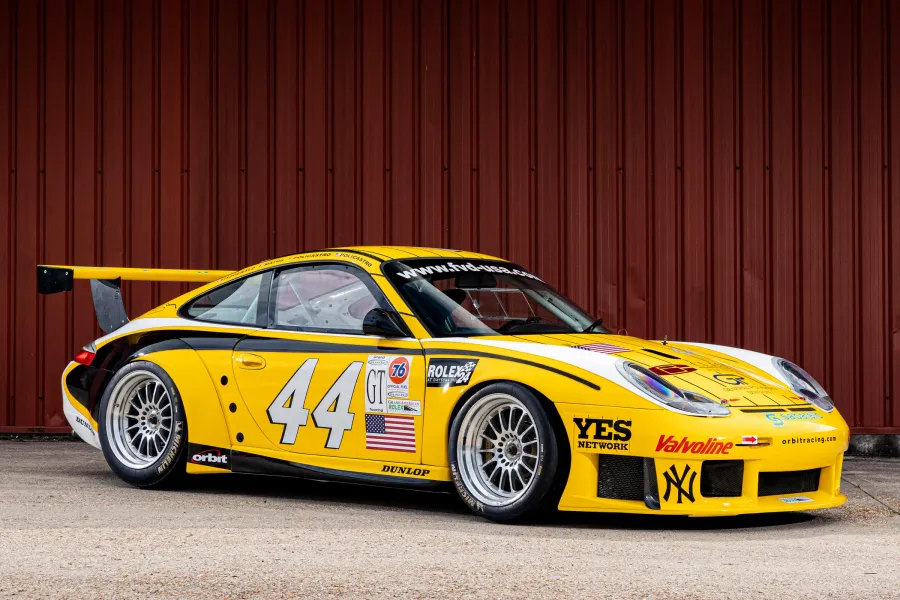







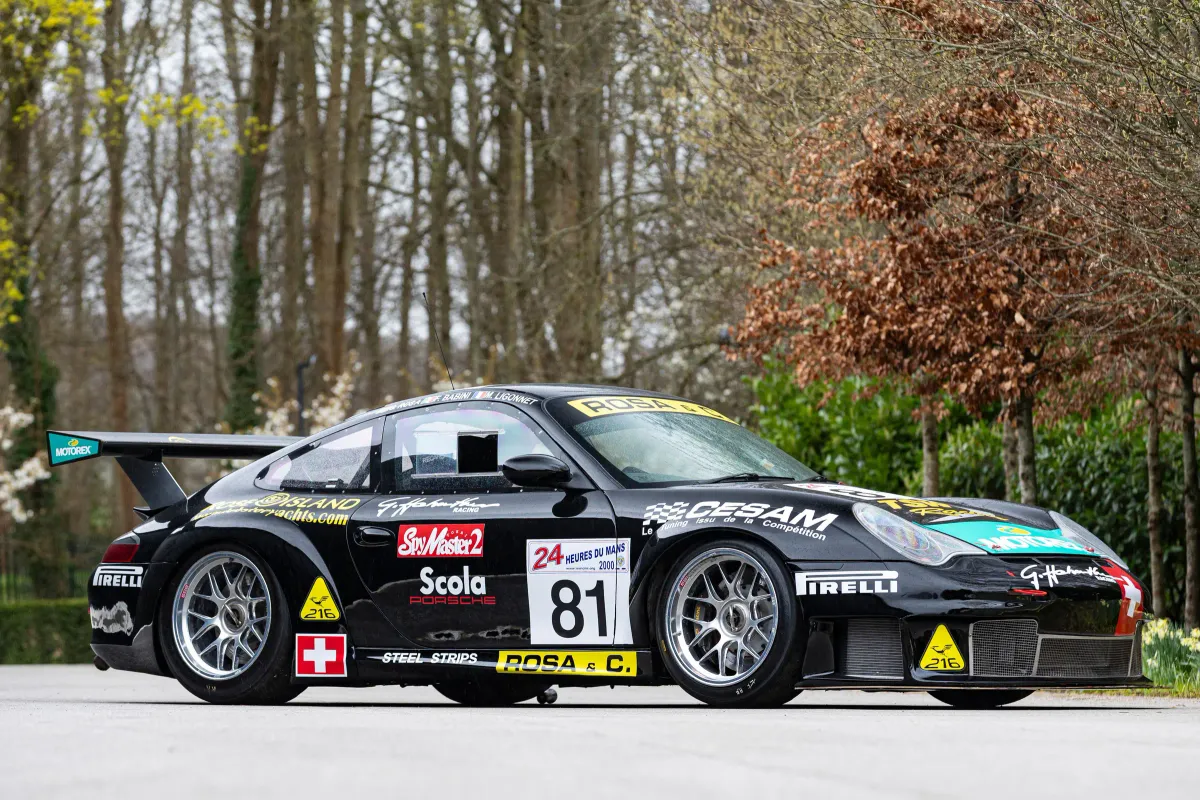
2000 Porsche 911 Type 996 GT3R RSR Race Car
Registration no. not registered
Chassis no. WP0ZZZ90ZYS692073
Estimate: £190,000 - £250,000
Class winner at the 2000 Daytona 24h
• Delivered new to Haberthur Racing
• Competed at Daytona and Le Mans in 2000
• Extensively campaigned by Eurotech 2001-2008
• Known ownership history from new
• New factory bodyshell in 2005
• Engine and transmission rebuilt in 2024 (run but not driven since)
Intended primarily for racing, though still road legal, the Porsche 911 GT3 takes its name from the FIA's GT3 category of production sports car racing, and has been produced in a variety of versions since its introduction in 1999 on the Type 996 iteration of the perennial 911, the 996 being the first to have a water-cooled engine. Known as the 996 GT3R, the racing version first appeared in 1999, making its competitive debut at that year's 24 Hours of Le Mans where it won its class. It would be the first of many such victories.
In the 2000 FIA GT Championship, the 996 GT3R dominated the new N-GT class and won every race. In 2001, the 996 GT3 was upgraded to RS specification and in this developed form would prove capable of scoring outright wins, prevailing at the Daytona 24 Hours and Spa-Francorchamps 24 Hours races in 2003 against much more powerful prototypes. The successor model 996 GT3 RSR made its debut in 2004. Engine power was increased from 415 to 455bhp and a six-speed sequential gearbox adopted.
This Porsche GT3 RSR has competed at Daytona and Le Mans and has an impressive racing record including the British GT, FIA GT and the Porsche Open. The Porsche was supplied new to Haberthur racing in 2000 for the Daytona 24 Hours race as a 911 GT3R. It won the GT class and finished 8th overall. Haberthur also entered the Porsche in the 2000 Le Mans 24 Hours. Running 2nd in class, the Porsche left the pits and had a 'bonnet up' incident. Amazingly, the driver was able to drive the car back to the pits, hanging out of the door to see where he was going! (Search online for the video.)
Immediately after the race the Porsche was sold to the Jones brothers and collected from the circuit by Mike Jordan, whose company would run the car throughout much of its life. In 2005, the Jones brothers upgraded the car to RSR specification including a factory RSR body, suspension system, wheels and brakes. The Porsche was also converted to right-hand drive shortly after Le Mans and homologated, and retained the original chassis number. All the rebuilding work was carried out by Eurotech/Mike Jordan.
In 2007 the car was sold to Gerry Harrison, passing to the current vendor's private collection in 2009. The 3.8-Litre engine was rebuilt in 2024, as was the transmission, and since then the engine has been run up in the garage only. The Porsche has also been repainted in its Le Mans 2000 livery.
The Porsche ran in period in the following events:
2000 Haberthur Racing Daytona 24 hours (1st in class), Le Mans 24 Hours (DNF)
2001 Eurotech British GT (Jones/Jones)
2002 Eurotech British GT (Jones/Jones)
2003 Eurotech FIA GT, Spa 24 Hours (Jones/Jordan/Jones)
2004 Eurotech British GT (Jones/Jones)
2004 Eurotech FIA GT, Spa 24 Hours (Jones/Jordan/Jones) – 8th Overall
2005 Eurotech British GT (Jones/Jones)
2006 Eurotech British GT (Jones/Jones)
2007 Eurotech Porsche Open (Harrison)
2008 Eurotech Britcar GT (Harrison)
We are advised that the car will require prep to make race ready, new fuel tank, seat belts etc to bring up to the latest FIA standard, but with the Peter Auto Endurance Racing Legends Series going from strength to strength this is a fabulous opportunity to enter a significant grid. We hope to see the car back at Le Mans racing at the Classic in the future, although hopefully without a repeat of its bonnet lifting!
Text & Image: Bonhams