





Coachwork by Bertone
Chassis no. 829ARO0001754
Engine no. 135G000-0006904
Estimate: €750,000 - €900,000/£650,000 - £780,000
Ex-Jolly Club – In the same ownership since 1984
• Genuine period Group 4 car
• Ex Maurizio Ambrogetti; Antonio Codognelli
• Prepared by University Motors – factory-approved specialist
• Active from 1976 to 1982 in nearly 40 rallies
• Entered in the 1977 Monte-Carlo Rally
• Only three owners since 1975
• Documented history and extensive file
• Significant recent work by Sports Cars in Modena and Giallo Corsa in Bergamo
• Supplied with a copy of its former Italian registration document
• FFVE certificate on file for French registration
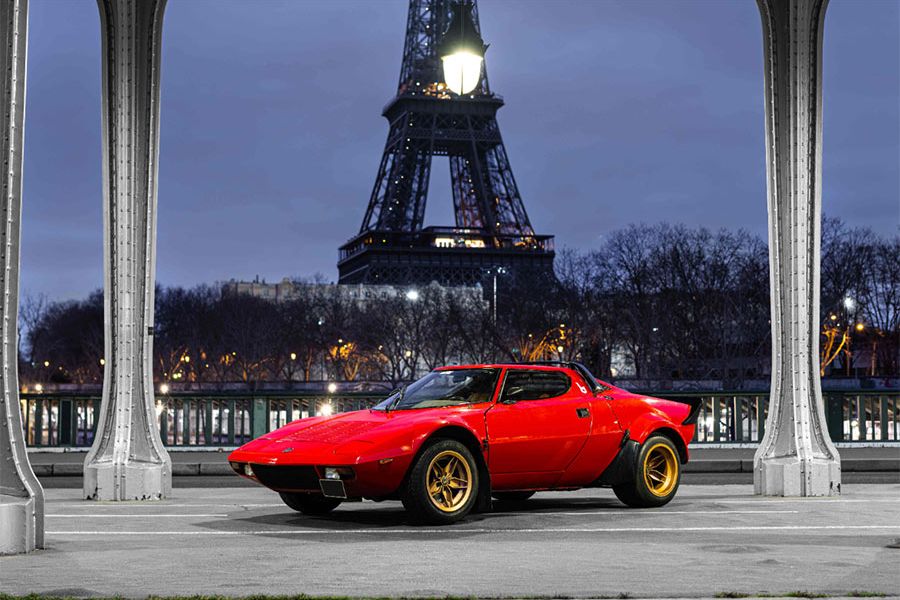
The Lancia Stratos, a limited-production "homologation special", holds particular historical significance as the first car from a major manufacturer designed specifically for rallying. Developed as Lancia's spearhead for international rallying in the 1970s, the Stratos originated from a Marcello Gandini design study based on Fulvia mechanicals, unveiled at the 1970 Turin Motor Show on the Bertone stand. The production Stratos of 1972, also designed by Gandini for Bertone, retained the striking wedge shape of the prototype but was powered by the formidable 2.4-litre Ferrari Dino V6. This was mounted within a steel monocoque chassis, clothed in a fibreglass body.
That such a concept reached production was largely due to Cesare Fiorio, co-founder of the HF racing team, which became Lancia's official competition department in 1965. Lancia had already achieved considerable success in international rallying with modified Fulvias, but with the Stratos, Fiorio saw the opportunity to create a purpose-built rally car from a clean sheet. He admired Ferrari's quad-cam V6, having already evaluated a Dino for rally use, and Enzo Ferrari was persuaded to supply the engines. The compact mid-engined Stratos bore little resemblance to conventional rally cars, but Fiorio's vision proved entirely correct.
As expected of a car designed to tackle all rally conditions, the Stratos featured fully independent suspension with double wishbones and coil springs, fully adjustable, along with four-wheel disc brakes. With 190 hp in road-going (Stradale) form, it could reach 225 km/h. Factory Group 4 rally cars were, of course, considerably more powerful, although early reliability issues delayed success. After its first major victory at the 1974 Targa Florio, the Stratos went on to dominate international rallying, with Lancia winning the World Rally Championship for manufacturers in 1975 and 1976. Factory driver Bernard Darniche secured two European Rally Championship titles in 1976 and 1977, and the Stratos also contributed to Markku Alén's early success in the inaugural World Rally Drivers' Championship in 1978. Ultimately, it was a political decision by parent company Fiat that led to its replacement by the Fiat 131, rather than any lack of competitiveness, although private entries continued to achieve success into the early 1980s.
Remarkably, once the required 500 cars for homologation had been produced, many remained unsold due to lack of demand (indeed, it is widely believed that only 492 were actually built). However, almost immediately after its retirement from competition, the car's historical significance was recognised and values began to rise.
This Lancia Stratos, chassis 1754, was delivered new in Italy in 1975 as an HF Stradale, but was immediately sent to University Motors—one of five factory-approved specialists (alongside Bosato, Facetti, Maglioli and Michelotto) authorised to prepare and maintain Stratos competition cars, all with access to factory parts and training—for conversion to full Group IV specification. Entered under the Jolly Club banner and registered X35788 MI, #1754 contested its first rally in June 1976 at the 4 Regioni, driven by Maurizio Ambrogetti.
Shortly thereafter, it was acquired by Antonio Codognelli. Having begun his competition career in 1973 with a Lancia Fulvia 1600 HF, Codognelli progressed steadily, entering a World Rally Championship round at San Remo in 1974. In 1975, after acquiring a Lancia Beta, he continued to develop his skills, finishing 12th at San Remo and enjoying a strong 1976 season, preparing himself for the formidable Stratos. By the end of 1976, following acquisition of #1754, he entered the Rally del Ciocco ahead of the 1977 Monte-Carlo Rally. Running number 177 in Jolly Club blue and white colours, Codognelli and co-driver Pippo Utenti retired, while Sandro Munari won the event in a factory Alitalia-liveried Stratos.
In March 1977, #1754 finished 9th overall at the Rally del Ciocco, led by a Stratos and followed by Fiat 131 Abarths and Opel Kadett GT/Es. In April 1977, Codognelli secured 10th place at the Coppa Città di Cesena.
Unfortunately, during the 1977 Rally 4 Regioni, with Vercesi as co-driver, Codognelli went off the road, seriously damaging #1754. Nevertheless, in true period fashion, the car was rebuilt using a replacement bodyshell from chassis #1682 and renumbered as #1754. Administratively, the car retained its registration, FIA papers and identity, but adopted the original yellow livery of #1682. It reappeared at the 1977 San Remo Rally, though unclassified, before achieving an excellent 3rd overall at the Coppa Luigi Feraboli shortly afterwards.
In December 1977, at the Rally Valle d'Aosta, Codognelli and Utenti retired on stage 8 after several top-10 stage times.
The 1978 season began strongly, with #1754 (now in yellow and red) finishing 2nd overall at the Rally Prealpi Orobiche with Serafino Rancati. This was followed by several top-10 finishes: 9th at the 4 Regioni; 8th at the Rally del Ciocco; 7th at the Coppa Luigi Feraboli; and 9th at the Rally Valle d'Aosta.
In 1979, the Stratos adopted white, then red livery, achieving notable results including 9th overall (3rd in class) at the Rally 100,000 Trabucchi and 5th overall (2nd in class) at the Rally Valle d'Aosta.
For 1980, now entirely red, #1754 contested seven rallies, including 7th at the Coppa Luigi Feraboli and 6th at the Rally Valle d'Aosta. In 1981, Codognelli continued with four events, notably finishing 2nd at the Rally Colline Oltrepò.
In its final competitive season in 1982, #1754 achieved some of its best results: 5th at the Rally Mille Miglia, 4th at the Rally Colline Oltrepò and 3rd at the Rally Mantova Corse.
In 1983, Codognelli retired the Stratos, later competing with Beta Montecarlo, 037 and Manta GT/E until 1987.
Chassis #1754 was acquired by its current and third owner in January 1984 via Garage Centrale Beretta in Lecco, then an official Lancia-Autobianchi dealer. The car was repainted black and subsequently maintained by FIA France Italie Automobiles in Levallois, using University Motors parts, as evidenced by a December 1984 invoice. From then on, the car was used primarily for leisure and preserved in good condition until a comprehensive refurbishment carried out in 2018 by Sports Cars in Modena and Giallo Corsa in Bergamo, including work on suspension, gearbox and engine.
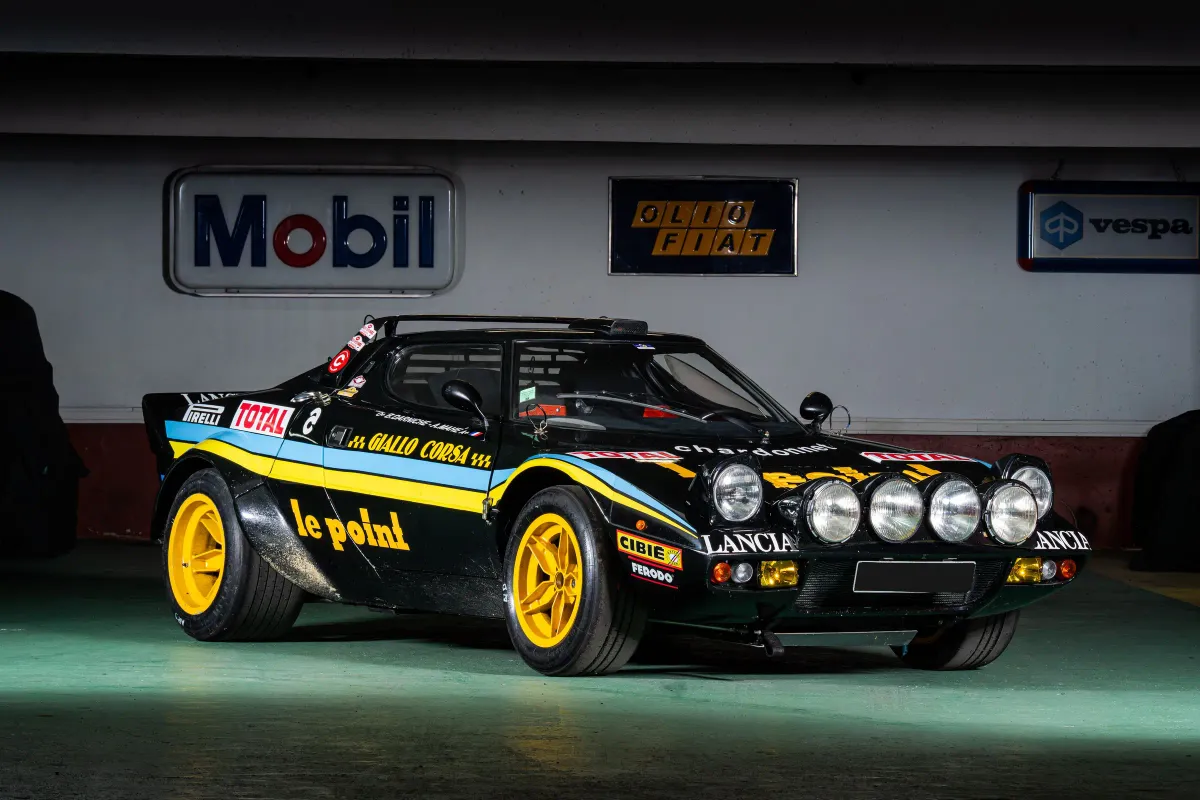
Today presented in the livery of the Stratos driven by Andruet to victory in the 1980 Tour de France Automobile, #1754 is one of the rare surviving examples from the Jolly Club Stratos era. Furthermore, it is highly unusual to find a Group IV Stratos that has remained in the same ownership for over forty years.
Offered with a copy of its Italian registration document in the name of Antonio Codognelli dated 1982, an extensive archive of rally photographs and results, an FFVE certificate, and numerous invoices from 1984 to the present day, this is a clearly documented example, eligible for the most prestigious historic events.
The Monaco Sale - 24 April 2026, 15:00 CEST Monaco, Fairmont Hotel
Text & Image: Bonhams